Changing bed sheets on a heavy mattress feels like a workout you never asked for. Every corner requires bending, twisting, and heaving that leaves your back screaming and sheets still coming loose at the edges. Whether you have a king-size pillow-top that weighs over 100 pounds, a memory foam mattress that seems to absorb every bit of force you apply, or you’re simply someone who changes linens frequently due to allergies, the physical toll of mattress lifting adds up fast. This guide walks you through proven techniques—from purely manual methods to specialized tools—that make sheet changes manageable without requiring a second person or risking your spine.
Why Heavy Mattresses Challenge Sheet Changes
Modern mattresses have evolved into comfort powerhouses that sacrifice ease of movement for a better night’s sleep. A standard queen-size pillow-top mattress weighs between 80 and 100 pounds, while king-size versions can exceed 120 pounds. Add memory foam layers, multiple comfort zones, and hybrid constructions, and you’re dealing with sleeping surfaces that demand serious physical effort to lift even a few inches. The problem compounds when these mattresses sit on box springs or within bed frames with minimal clearance—creating a gap too narrow for hands to fit yet too wide to simply tuck sheets underneath without elevation.
The physical strain of repeated mattress lifting affects your entire upper body. Your lumbar spine bears the brunt when you bend at the waist instead of your knees. Your shoulder girdle fatigues as you grip and hold corners while simultaneously trying to work sheets into place with your free hand. Even your neck muscles tense from the awkward angles required to see what you’re doing under the mattress edge. For elderly individuals, caregivers, or anyone with pre-existing back conditions, these daily or weekly demands can transform a simple chore into a painful ordeal that either gets neglected or requires professional assistance—both undesirable outcomes.
Effective Manual Lifting Techniques Without Tools
When specialized equipment isn’t available, certain techniques minimize strain while still achieving the lift necessary for sheet changes. The most effective approach involves lifting from corners rather than the center, as corners provide natural leverage points that reduce total force required. Position yourself shoulder-width apart with your knees slightly bent, grip the mattress corner with both hands, and lift using your leg muscles rather than your back. Hold the mattress just high enough to create space for your other hand to tuck sheets, then switch positions and repeat across all four corners.
A rocking motion offers an alternative for those who find continuous lifting exhausting. Rather than attempting to raise the mattress in one motion, rock it incrementally at each corner—back and forth—gradually working it upward until sufficient clearance exists for sheet tucking. This technique reduces peak force demands but extends total completion time. Some users find that using their knee as a support point helps distribute the load more effectively: place one knee on the mattress edge while that leg pushes upward, reducing arm and back strain. Never hold your breath during lifting—exhale as you lift to maintain core stability and prevent blood pressure spikes.
How the Bed MadeEZ Mattress Lifter Solves Your Problem

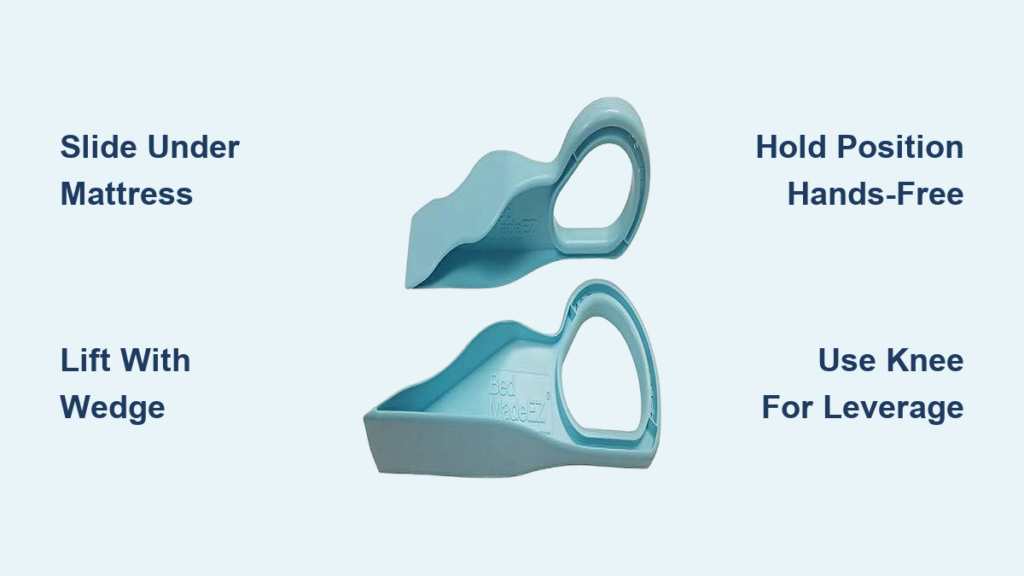
The Bed MadeEZ Mattress Lifter provides purpose-built relief for this common household challenge. Manufactured by CKI Solutions in the United States, this patented tool functions as an inclined wedge that slides between mattress and box spring, mechanically lifting and holding the mattress in a raised position without requiring you to maintain pressure. With over 6,400 customer reviews earning a 3.9 out of 5 star rating, the tool has proven its value across diverse households and bed configurations.
The mechanism works through simple but effective engineering: slide the inclined wedge along the gap between mattress and box spring, then push it further in to progressively elevate the mattress surface. The wedge shape naturally separates and lifts, creating 4 to 5 inches of clearance—ample space for hands to work in, tuck sheets, position bed skirts, or complete other bed-making tasks. Once inserted, the tool holds the mattress raised without ongoing effort, transforming a two-handed lifting job into a one-handed insertion task followed by completely hands-free sheet manipulation. The curved handle offers multiple grip positions, accommodating different body types and the specific corner you’re working on.
Key Specifications of the Mattress Lifting Tool
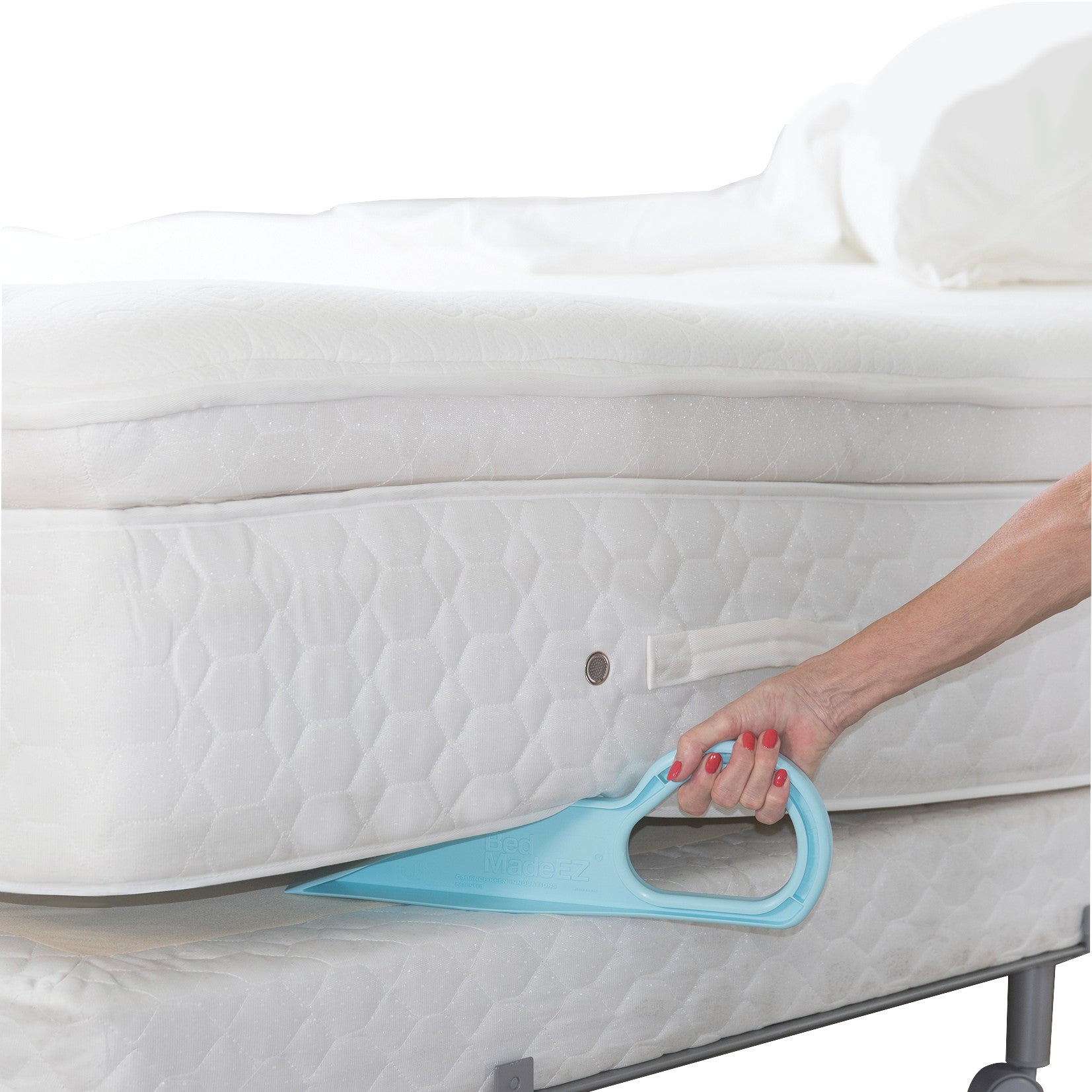
The Bed MadeEZ Mattress Lifter is constructed from polypropylene, a durable plastic that provides reliable strength for mattress support while remaining lightweight for easy handling. The product measures 16 inches long, 3 inches wide, and 5.5 inches tall—dimensions optimized to deliver substantial lifting leverage while staying compact enough for convenient closet or drawer storage between uses. At just 9.9 ounces, the tool adds negligible weight to your burden during bed-making and moves easily around the bed as needed.
Critical features to know:
– Fully assembled with no setup required
– Limited lifetime warranty from CKI Solutions
– Curved handle for multiple grip positions
– Designed specifically for mattress-to-box spring gaps
– Works best with standard bed frames (avoid high-lip frames)
The design incorporates ergonomic principles developed through consideration of real-world bed-making scenarios. This isn’t a complex device requiring instruction manuals or practice sessions; its simplicity contributes directly to its effectiveness and accessibility for users of varying physical abilities.
Essential Safety Guidelines for Mattress Lifting
Even with specialized tools, proper usage requires attention to safety considerations that ensure effectiveness and protect both user and equipment. Never force the tool into position with sudden movements—the polypropylene material can potentially crack under excessive force. Insert the tool smoothly and steadily, using your knee to drive it into position for most users. Ensure you’re pushing against stable surfaces rather than risking loss of balance during insertion.
The manufacturer warns against using the tool with bed frames that have high lips or raised edges, as these configurations can prevent proper insertion or create unstable lifting conditions. Before each use, briefly inspect the tool for cracks, warping, or wear signs that might compromise performance—catching potential problems before they occur during a sheet-changing session prevents frustration and maintains safety. Individuals with limited physical strength should assess whether their mattress falls within the tool’s practical capacity before attempting use.
Alternative Tools and Complementary Approaches

Beyond dedicated mattress lifters, several tools work alongside or instead of the Bed MadeEZ to simplify heavy mattress sheet changes. The Extra Long Bed Sheet Tucker features extended handles and paddle-like ends that push sheet edges deep under mattresses without requiring hands to fit into narrow gaps. When paired with a mattress lifter, these tools create a comprehensive system addressing both lifting and tucking components of bed-making.
For households without specialized equipment, household items offer partial solutions:
– Rolled towels or pool noodles placed along mattress edges provide temporary lifting support
– Long-handled brooms can push sheets into place after manual lifting
– Pool noodles cut in half lengthwise create stable edge supports
These improvised approaches require more time and effort than dedicated tools while delivering less consistent results. The investment in proper equipment quickly pays off for those who change sheets weekly or more often—the efficiency gains compound with each use.
Proper Body Mechanics to Prevent Injury
Whether using tools or relying on manual techniques, proper body mechanics dramatically reduce injury risk during mattress lifting. Before beginning sheet changes, perform gentle stretches focusing on hamstrings, lower back, and shoulders to warm up muscles that will be engaged throughout the process. Throughout lifting, maintain a shoulder-width stance that provides stable base support, distributing forces safely through your legs rather than concentrating them in your spine.
Critical body mechanics to implement:
– Keep the load close to your body to minimize leverage forces
– Bend at knees and hips, not your waist
– Exhale during active lifting phases, inhale during repositioning
– Take regular breaks to prevent cumulative fatigue
For those with pre-existing back conditions, these principles become even more critical, and assistive tools prove invaluable for maintaining independence in household tasks. The moment you feel strain building, stop and reposition—pushing through pain leads to injury.
Bed Setup Considerations for Easier Sheet Changes
Your specific bed configuration determines which lifting approaches work best. Platform beds with low profiles and minimal floor clearance present different challenges than traditional frames with box springs that create natural separation between sleeping surfaces. Adjustable base beds introduce additional complexity, as articulating mechanisms limit tool insertion points and may create pinch points.
Mattress height relative to surrounding frames also influences strategy. Mattresses sitting flush with or below frame tops offer fewer manual grip points but often work better with wedge-style lifting tools. Mattresses extending above frames provide easier manual gripping but may require more force to lift sufficiently for sheet tucking. Bed skirts and decorative elements add complexity, requiring even greater clearance than simple sheet tucking. Assessing your specific setup before beginning sheet changes—and adjusting your approach accordingly—leads to more efficient bed-making.
Who Benefits Most from Mattress Lifting Tools
Different user populations gain distinct advantages from dedicated mattress lifting solutions. Elderly individuals, particularly those living alone, face reduced physical strength combined with heightened consequences from lifting injuries. For this group, tools like the Bed MadeEZ enable independent sheet changes that might otherwise require caregiver assistance—the simple operation of sliding, pushing with a knee, and achieving lift requires minimal learning.
Caregivers responsible for multiple beds accumulate repetitive strain that affects their own health over time. Investing in quality lifting tools for each bed enables efficient workflow while protecting the caregiver’s body. Time savings from efficient sheet changes offset tool costs, especially when multiplied across many beds over months and years. Allergy sufferers who change sheets frequently—weekly or more often—similarly benefit from tools that make frequent bed-making manageable without accumulating physical strain with each repetition.
Cost Analysis and Practical Value
The Bed MadeEZ Mattress Lifter carries a one-time price of $21.95, making it an accessible investment for most households. When evaluated against potential back injury costs, professional assistance fees, or ongoing physical discomfort from struggling with heavy mattresses, this price point delivers substantial value. The limited lifetime warranty enhances the proposition by ensuring product replacement if manufacturing defects emerge during normal use.
For those uncertain about committing to a dedicated tool, the price point minimizes financial risk of experimentation. Test the tool with your specific bed configuration to verify compatibility before depending on it for regular use. Investing in proper mattress lifting equipment transforms a physically demanding task into an accessible one—a practical solution to a common household challenge that pays dividends with every sheet change. The true value isn’t just in the tool itself, but in the years of pain-free bed-making it enables.