Your futon’s comfort and longevity depend entirely on selecting the right mattress—a decision that transforms basic furniture into both a supportive sleep surface and comfortable seating. Too many shoppers make the mistake of treating futon mattress selection like traditional bed shopping, only to discover their “perfect” choice feels uncomfortable as seating or collapses after months of use. This guide cuts through the confusion with specific, actionable advice that helps you navigate size charts, material comparisons, and frame compatibility issues so you get a futon that works perfectly for your lifestyle.
Unlike conventional mattresses that serve one purpose, futon mattresses must perform double duty—providing firm enough support for healthy sleep while offering cushioning that makes daytime seating enjoyable. Whether you’re furnishing a studio apartment, guest room, or college dorm, knowing how to choose a futon mattress that matches your actual usage patterns prevents costly mistakes and ensures years of satisfaction. You’ll learn exactly which materials withstand daily folding, how thickness affects both comfort and frame compatibility, and why your sleeping position should dictate firmness more than marketing claims.
Match Mattress to Your Use Frequency
Your futon’s daily role determines which mattress characteristics matter most—ignoring this factor leads to premature wear or unnecessary spending on features you’ll never use.
Occasional guest use calls for economical cotton or basic foam mattresses that cost significantly less than premium options. These lightweight choices fold easily for storage and provide adequate comfort for visitors without breaking your budget. If your futon spends 95% of its time as seating, spending $500 on a latex mattress makes little sense—you’ll get similar performance from a $150 cotton model that won’t bankrupt you when it compresses after a year of sporadic use.
Daily sleepers need premium constructions that withstand nightly use without sagging. High-density foam, innerspring, or latex futon mattresses provide the resilience required for regular sleeping, with quality models lasting 7-10 years compared to 1-2 years for budget options. Look for mattresses with at least 8 inches of thickness and multi-layer construction—these maintain support even after thousands of fold cycles. The initial investment pays off through better sleep quality and avoiding replacement costs every few years.
Mixed-use scenarios require balance between sleeping comfort and seating durability. If your futon converts between sofa and bed multiple times weekly, prioritize medium-firm hybrids that cushion hips during sleep while resisting permanent compression from daily sitting. These typically combine a cotton base for structure with 1-2 inches of foam or latex for surface comfort—providing enough give for comfortable seating without sacrificing spinal alignment during sleep.
Select Material Based on Sleep Position

Your natural sleeping posture dictates which futon mattress materials will keep your spine properly aligned—choosing against this leads to discomfort no amount of padding can fix.
Side sleepers need softer surfaces that allow shoulders to sink slightly without bottoming out. Medium-soft foam or hybrid futons work best, providing enough cushioning to relieve pressure points while maintaining support underneath. If your futon feels too firm when lying on your side, you’ll develop shoulder and hip pain within weeks of regular use. Pro tip: Test mattresses with your arm tucked under your head to simulate side-sleeping pressure points.
Back sleepers benefit from firm support that maintains your spine’s natural curve without creating pressure on the lower back. Medium-firm cotton, innerspring, or dense foam futons provide consistent support across your entire body while allowing subtle contouring in the lumbar region. Avoid ultra-plush constructions that cause your pelvis to tilt and create lower back strain during extended sleep.
Stomach sleepers require the firmest options to prevent midsection sinking that forces neck extension. Firm cotton or innerspring futons with minimal cushioning create the flat, supportive surface this position demands. Without adequate firmness, stomach sleepers frequently wake with neck pain—the slightest sinkage misaligns the spine when lying prone.
Body weight changes firmness perception—a medium-firm mattress may feel soft to heavier individuals. If you weigh over 200 pounds, size up in firmness or select high-density materials that resist compression. Heavier futons often indicate denser construction—look for weights of 40+ pounds for queen size as a rough quality indicator.
Find Your Perfect Size and Thickness
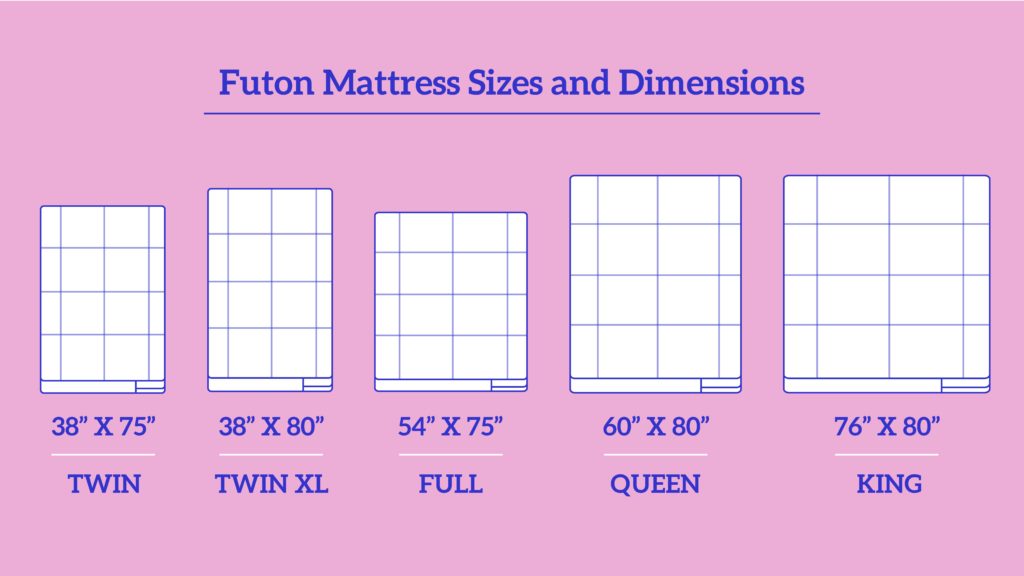
Selecting dimensions that accommodate both your body and space prevents cramped sleeping and awkward furniture arrangements that dominate your room.
Calculate ideal length by adding 14 inches to your height. A six-foot person needs at least 86 inches of sleeping surface—making Twin XL (80-83 inches) the minimum practical size. Standard twins (75 inches) leave taller sleepers with feet hanging off the edge, disrupting sleep quality through restricted movement.
Determine width needs by measuring your shoulder span plus 12 inches minimum. A person with 20-inch shoulders requires at least 32 inches of width—adequately covered by twin (39 inches) but more comfortable in full (54 inches). Critical mistake: Couples often try to squeeze onto full-size futons (54 inches), leaving only 27 inches per person—less than a crib. Queen size (60 inches) provides the minimum 30 inches per adult for comfortable co-sleeping.
Thickness affects both comfort and function—thinner isn’t always better. For daily sleepers, 8-inch futons provide the best balance of cushioning and support, masking frame bars that create pressure points in thinner models. Occasional users can opt for 6-inch options that fold more easily for storage. Traditional floor sleepers should consider 4-inch shikibuton styles designed specifically for tatami mats.
Frame compatibility is non-negotiable—a queen mattress won’t work on a full frame regardless of how close the dimensions seem. Measure your frame’s sleeping surface before ordering, and verify thickness compatibility—most frames specify acceptable mattress depths in their manuals. Using an incompatible thickness creates gaps that strain conversion mechanisms and cause premature wear.
Choose Fillings for Your Specific Needs
The internal materials determine your futon’s comfort, durability, and price—understanding each option’s strengths prevents mismatched purchases.
Foam futons dominate modern comfort standards with memory foam variants offering exceptional pressure relief. They provide uniform support across all sleep positions and last longer than most alternatives—typically 8-10 years with nightly use. Warning: Cheap foam (below 1.5 lb density) compresses quickly; look for high-density options (2.0+ lb) that maintain support. Memory foam’s main drawback is heat retention—consider gel-infused varieties if you sleep hot.
Spring futons offer familiar bounce at mid-range prices but come with significant limitations. Their weight makes folding difficult, metal coils can create noise as they age, and repeated folding gradually damages the coil structure. Best suited for dedicated bed applications where conversion happens rarely, not daily sofa-bed hybrids.
Cotton futons provide traditional firm support and lightweight portability ideal for occasional use. They excel in portability but compress significantly with nightly use—most require replacement after 2-3 years of regular sleeping. Perfect for guest rooms or vacation homes where the futon stays folded 90% of the time.
Latex futons represent premium durability for primary beds, often lasting 15-20 years with proper care. Natural latex conforms gently to body curves without memory foam’s deep sinkage, creating supportive surfaces suitable for all positions. The significant upfront cost ($800+) pays off through longevity—just ensure your frame can handle the substantial weight (queen sizes often exceed 70 pounds).
Set a Realistic Budget Based on Usage
Futon costs range from $100 to $1,500—establishing appropriate spending expectations prevents both overspending and false economy.
Calculate true cost per use by dividing purchase price by expected lifespan. A $150 cotton futon lasting 2 years of nightly use costs $0.21 per night, while a $600 foam model lasting 8 years costs just $0.21 per night—making them equally economical despite the price difference. For guest rooms used 10 nights yearly, the cheaper option wins; for daily sleepers, invest in quality.
Prioritize spending based on frequency—if your futon converts daily, allocate 60-70% of your budget to mattress quality and 30-40% to the frame. For occasional use, reverse these ratios since the frame will experience minimal stress. Most shoppers make the mistake of buying cheap mattresses with expensive frames, dooming their setup to premature failure.
Final Selection Checklist
Before purchasing, verify these critical factors to ensure your futon meets real-world needs:
- Usage pattern match: Does the mattress construction align with daily/occasional use?
- Sleep position compatibility: Will firmness support your natural sleeping posture?
- Frame measurements: Have you verified size and thickness compatibility?
- True cost analysis: Does the price reflect expected lifespan for your usage?
- Return policy: Does the seller offer at least 30 days to test comfort in your space?
The right futon mattress for your situation exists—you just need to match its specifications to your actual living patterns rather than marketing hype. Whether you need a durable daily sleeper for your studio apartment or a compact guest solution for your home office, applying these selection criteria ensures you get a futon that performs perfectly for years. Stop compromising between seating and sleeping comfort—your ideal dual-purpose mattress awaits with the right selection strategy.