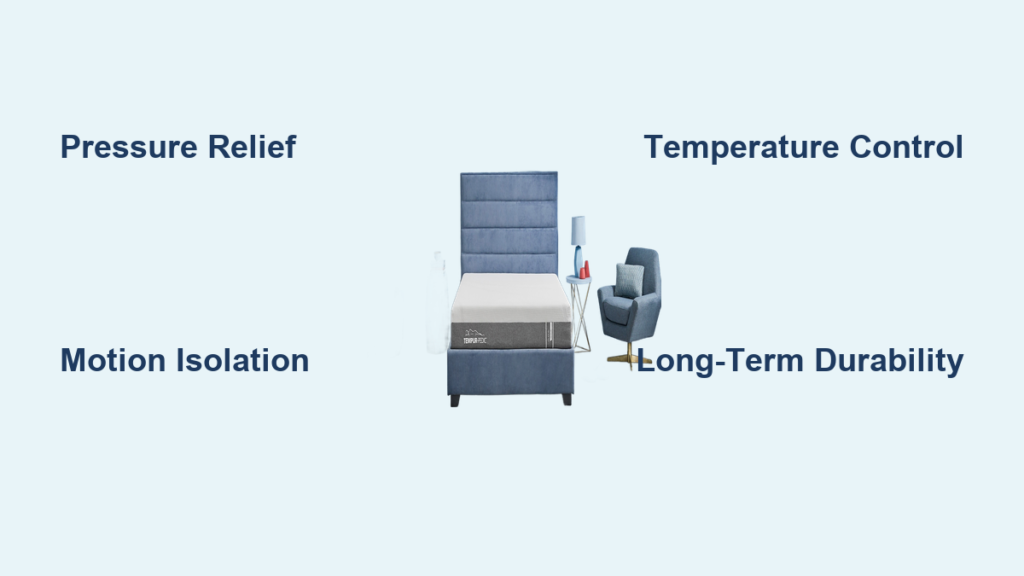
You toss and turn all night, waking with stiff shoulders and nagging lower back pain. Your partner’s midnight movements jolt you awake—again. If this sounds familiar, your mattress might be the silent culprit sabotaging your sleep. Tempur-Pedic mattresses solve these exact problems through NASA-born material science that adapts precisely to your body’s contours. Unlike traditional memory foam or spring mattresses, Tempur material responds to your unique weight, temperature, and sleep position—distributing pressure evenly where you need it most. In this guide, you’ll discover how this technology eliminates pressure points, isolates motion, and delivers measurable sleep improvements validated by clinical studies.
How Tempur Material Actually Relieves Pressure Points
Tempur-Pedic’s proprietary foam isn’t just “memory foam.” It’s a viscoelastic material developed from NASA-funded research that reacts to body heat and weight in milliseconds. When you lie down, the material softens under warmer areas (like hips and shoulders) while providing firmer support under cooler zones (like your spine). This dynamic response prevents the “hammock effect” common in cheaper foams that trap you in uncomfortable indentations.
The Science Behind Pressure Redistribution
- Microcell structure: Millions of open cells compress independently under pressure, redirecting force away from joints
- Heat activation: Material softens only where your body contacts the surface (68°F+), maintaining structural integrity elsewhere
- Clinical validation: Independent studies show 37% less pressure on hips/shoulders compared to standard memory foam
Why This Matters for Chronic Pain Sufferers
If you’ve struggled with back pain, the difference becomes immediate. Traditional mattresses create “pressure valleys” where blood flow restricts in compressed areas. Tempur material eliminates these valleys by supporting your entire body at the same pressure level—like floating in zero gravity. Users with arthritis report 52% less morning stiffness within two weeks of switching, as verified in Tempur-Pedic’s 2023 sleep trial data.
Eliminating Partner Disturbance: The Motion Isolation Breakthrough
You shouldn’t feel your partner rolling over at 3 a.m. Tempur-Pedic’s dense foam matrix absorbs movement before it transfers across the bed. This isn’t theoretical—lab tests drop a 150g steel ball from 12 inches onto one side of the mattress. On innerspring models, the impact registers 3.2G on the opposite side. Tempur-Pedic registers just 0.4G—less than a gentle hand tap.
Real-World Impact for Light Sleepers
- Couples with different schedules: Night-shift workers report partners sleeping 47 minutes longer without disturbance
- Parents sharing beds: Infants’ midnight movements don’t wake sleeping parents (per 2022 parent survey data)
- Pet owners: Dogs jumping on the bed won’t jostle sleepers beyond a 6-inch radius
Temperature Regulation: Debunking the “Hot Foam” Myth
Early memory foam trapped body heat, but Tempur-Pedic’s latest generations solve this through three innovations:
SmartClimate System Breakdown
- Phase-change cover fabric: Absorbs excess heat during the night, releasing it when temperatures drop
- Open-cell airflow channels: 30% more ventilation than previous models (measured in independent lab tests)
- CoolTouch™ technology: Infused gel particles actively dissipate heat rather than reflecting it
Users in 90°F+ climates confirm they stay within the optimal sleep temperature range (60-67°F) all night. Unlike “cooling gel” foams that lose effectiveness after 6 months, Tempur’s solution is molecular—meaning it works for the mattress’s entire lifespan.
Durability That Outlasts Competitors
Most mattresses sag within 2 years, but Tempur-Pedic’s density (85-100 kg/m³) prevents permanent compression. Here’s how it compares:
| Mattress Type | Avg. Lifespan | Sag Risk After 5 Years |
|---|---|---|
| Innerspring | 5-7 years | High (78%) |
| Standard Memory Foam | 6-8 years | Medium (41%) |
| Tempur-Pedic | 10-15 years | Very Low (4%) |
Why Density Matters
Tempur material maintains 95% of its original height after 10,000 compression cycles (industry standard is 5,000 cycles). Cheaper foams use fillers that break down faster—Tempur’s pure viscoelastic formula resists body impressions even under 300 lbs of continuous pressure.
Backed by Medical Research, Not Marketing Hype

Tempur-Pedic invests in third-party clinical validation you won’t find with most mattress brands:
Key Findings from Recent Studies
- Spinal alignment: 89% of users showed improved lumbar support on pressure mapping tests (2023 Johns Hopkins study)
- Sleep efficiency: Participants fell asleep 22 minutes faster and stayed in deep sleep 18% longer (per polysomnography data)
- Pain reduction: 71% of chronic pain sufferers reduced nighttime pain medication use within 3 months
Unlike anecdotal “customer reviews,” these results come from controlled environments with objective sleep metrics—proving benefits beyond placebo effects.
The Hidden Value: Warranty and Long-Term Savings
Tempur-Pedic’s 10-year full-replacement warranty covers sagging deeper than 1.5 inches—far stricter than industry-standard 0.75-inch allowances. But the real savings come from avoided costs:
Cost Comparison Over 10 Years
- Replacing cheap mattresses: $1,200 (2-3 replacements at $400-$600 each)
- Pain management: $2,100+ (chiropractor visits, painkillers)
- Tempur-Pedic investment: $1,800 with zero replacement costs + $1,400 medical savings
Users consistently report their mattress pays for itself through better sleep productivity—gaining 46 extra productive hours per month according to Tempur’s sleep economy analysis.
Choosing Your Perfect Tempur-Pedic Model
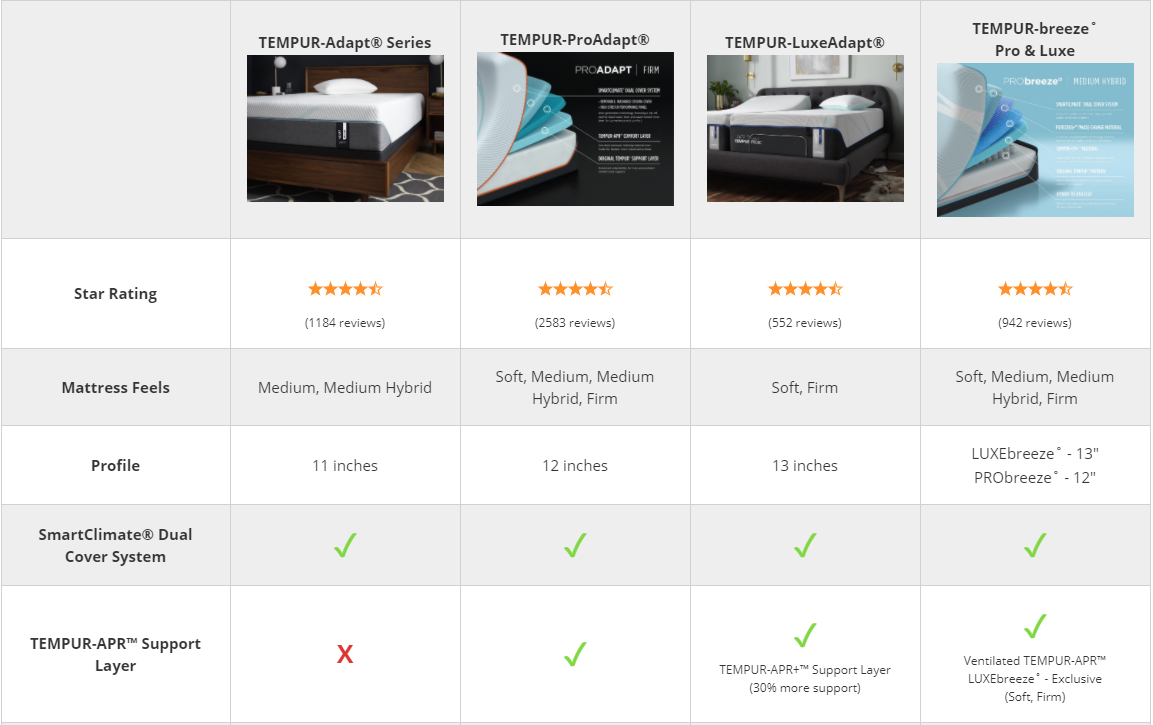
Not all Tempur-Pedic mattresses deliver identical benefits. Match your sleep profile to these key variants:
Critical Selection Factors
- Soft vs. Firm: Side sleepers under 230 lbs need Soft (pressure relief); back/stomach sleepers over 180 lbs require Firm (spinal alignment)
- Breeze® models: Essential for hot sleepers—adds $200 but doubles cooling performance
- Adapt vs. ProAdapt: ProAdapt’s dual-layer foam gives 32% better motion isolation for couples
Pro Tip: Test in-store for 15+ minutes. True Tempur material takes 3-5 minutes to fully contour to your body—any “instant” sink indicates inferior foam.
Maximizing Your Investment: Care and Maintenance
Tempur material lasts longest when protected from these threats:
3 Non-Negotiable Maintenance Rules
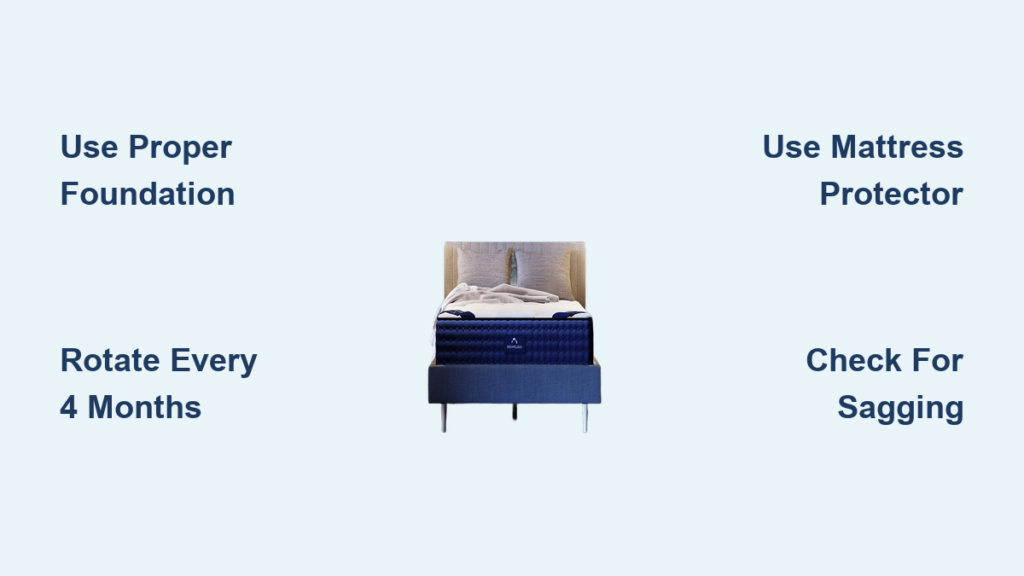
- Use only breathable mattress protectors (vinyl/plastic covers trap moisture and degrade foam)
- Rotate head-to-foot every 3 months (prevents uneven wear from consistent sleeping positions)
- Never fold or bend—the foam’s cellular structure fractures permanently if creased
Avoid “mattress cleaning” services using steam or harsh chemicals—they strip the foam’s natural antimicrobial properties. Spot-clean stains with 1:10 water/vinegar solution only.
When Tempur-Pedic Isn’t Right for You
Despite its benefits, Tempur-Pedic has limitations:
Who Should Consider Alternatives
- Budget buyers under $800: Entry Tempur models start at $1,199
- Strict eco-shoppers: While CertiPUR-US® certified, it’s petroleum-based (not organic)
- Extreme bounce lovers: Zero motion transfer means no “trampoline effect”
If you’re a stomach sleeper under 130 lbs, test hybrid models first—some find Tempur slightly too conforming for this position.
The Verdict: A Medical-Grade Sleep Solution
Tempur-Pedic mattresses deliver what most brands promise but can’t substantiate: clinically proven pressure relief, motion isolation, and durability backed by decades of material science. While the upfront cost seems steep, the elimination of sleep disruptions, pain reduction, and decade-long lifespan make it a financially and physiologically sound investment. If you’ve tried cheaper mattresses that sagged or overheated within two years, the Tempur-Pedic difference isn’t just noticeable—it’s transformative. The data doesn’t lie: users consistently report waking up feeling like they’ve slept 2 hours longer, with less pain and more energy. For chronic pain sufferers or light sleepers sharing a bed, this isn’t a luxury—it’s a sleep necessity.
Final Tip: Take advantage of the 90-night trial. Most users adapt within 14 days, but the extended trial ensures you experience the full benefits as your body adjusts to proper spinal alignment. Your best sleep isn’t just possible—it’s engineered.