Waking up with aches and pains often traces back to your mattress foam composition. The right foam types for mattress construction can mean the difference between restorative sleep and restless nights. Modern mattresses employ scientifically engineered foam materials with precise density ratings, firmness levels, and performance characteristics that directly impact spinal alignment, pressure point relief, and temperature regulation. Understanding these technical specifications—rather than relying on marketing terms—empowers you to select sleep surfaces that match your body’s biomechanical needs. This guide details the exact foam formulations used by manufacturers, including their density measurements, indentation load deflection (ILD) ratings, and real-world performance data to help you make an informed decision for better sleep.
Memory Foam: Pressure-Relieving Contouring Technology
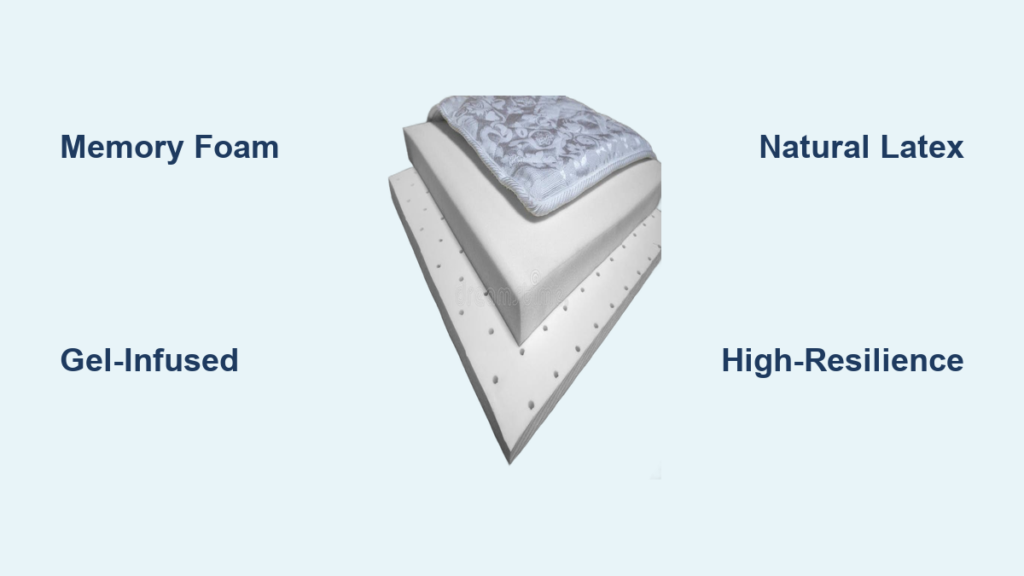
Memory foam creates personalized support by responding to both body weight and temperature, softening at contact points while maintaining firm support beneath heavier body regions. This viscoelastic polyurethane foam features a density of 2.50-2.60 pounds per cubic foot and a 12.0 ILD rating that delivers moderate contouring without excessive sinkage. The closed-cell structure provides exceptional motion isolation, making it ideal for couples as movement on one side doesn’t transfer across the mattress.
Why memory foam develops body impressions over time
Memory foam’s tendency to develop permanent impressions correlates directly with its medium density range. Under consistent pressure from body weight, the material gradually loses resilience in concentrated areas. This degradation typically occurs within five to seven years of regular use, though higher-density memory foams (above 3.0 pounds per cubic foot) maintain their structural integrity longer. Proper rotation and foundation support can extend service life by distributing compression forces more evenly across the sleep surface.
Gel-Infused Memory Foam: Temperature-Controlled Comfort
Gel-infused memory foam solves the heat retention problem of traditional memory foam by incorporating blue gel particles that absorb and dissipate body heat. This advanced formulation maintains the same 2.50 pounds per cubic foot density as standard memory foam but features a softer 10.9 ILD rating for deeper contouring. The gel particles function as thermal conductors, creating additional heat transfer pathways through the foam structure.
How gel infusion extends mattress lifespan
The typical service life of gel-infused memory foam reaches approximately eight years—nearly two years longer than conventional memory foam. This extended durability likely stems from the gel particles reinforcing the foam’s cellular structure against compression set formation. The improved thermal regulation also reduces heat-related degradation of the polymer matrix, preserving the material’s resilience throughout its service life while maintaining superior pressure relief capabilities.
Natural Latex Foam: Responsive Plant-Based Support

Natural latex foam, derived from rubber tree sap, delivers immediate responsiveness that eliminates memory foam’s slow recovery time. With a premium density range of 4.40-5.60 pounds per cubic foot and ILD values spanning 16.00-43.00, this material accommodates diverse firmness preferences while providing exceptional durability. The open-cell structure promotes natural breathability without requiring artificial cooling technologies.
Why natural latex prevents chemical sensitivities
Unlike petroleum-based foams, natural latex contains zero volatile organic compounds (VOCs) and requires no fire retardant additives, making it ideal for chemically sensitive individuals. The eco-INSTITUT certification verifies 100% botanical composition, confirming the absence of synthetic components that could trigger respiratory issues or off-gassing concerns. This natural resistance to dust mites, mold, and bacteria further enhances sleep hygiene for allergy sufferers.
Organic Latex Foam: Certified Chemical-Free Sleep

Organic latex foam meets the rigorous Global Organic Latex Standard (GOLS) with over 95% certified organic content. This premium material maintains the same performance characteristics as natural latex but follows strict organic cultivation protocols that prohibit synthetic pesticides and fertilizers throughout the rubber tree growing process. The density range of 3.45-5.95 pounds per cubic foot and ILD values from 11.00-45.00 provide manufacturers flexibility to create customized sleep surfaces.
How organic certification impacts foam quality
GOLS certification ensures organic integrity extends beyond raw materials to encompass the entire production chain. Organic compounds replace synthetic chemicals during processing, preventing cross-contamination that could compromise purity. This attention to detail preserves the material’s natural elasticity and pressure-relieving properties while delivering the chemical-free sleep environment that defines organic latex positioning in the marketplace.
Qualux High-Resilience Foam: Premium Support Longevity
Qualux High Resilience foam represents the premium polyurethane tier with a density range of 2.5-3.0 pounds per cubic foot and ILD values from 35-61. Its unique cellular architecture provides progressive support—initially soft for pressure relief, then firming appropriately under deeper compression. This responsive characteristic creates balanced support that outperforms conventional foam alternatives.
Why Qualux foam maintains performance for 15 years
The minimum sag factor of 2.50 indicates exceptional resistance to progressive compression under sustained loading. In rigorous testing that simulates extended use through constant force pounding, Qualux foam preserves thickness and support characteristics far longer than competing materials. This structural integrity translates to approximately fifteen years of service life—nearly double that of standard memory foam—making it a cost-effective investment for long-term sleep quality.
Soft Foam: Plush Comfort That Lasts
Soft foam delivers exceptional pressure relief with a very soft 10 ILD rating while maintaining structural integrity through high-resilience engineering. At 2.50 pounds per cubic foot density, this material combines the cushioning qualities of memory foam with responsive recovery that prevents permanent deformation. The minimum sag factor of 2.7 demonstrates resistance to progressive compression under sustained loading.
How soft foam avoids the “sinking” problem
Unlike conventional soft foams that trap sleepers in deep impressions, high-resilience soft foam provides a buoyant feel that sleepers describe as “floating on the surface.” This immediate recovery to original dimensions after compression allows for easier position changes during sleep while still delivering the deep pressure relief that side sleepers require for shoulder and hip alignment.
Hard Foam: Maximum Orthopedic Support
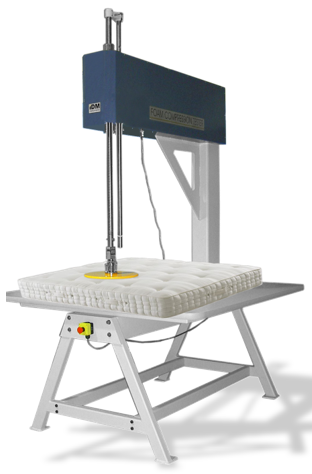
Hard foam provides maximum support with an extremely firm 240 ILD rating and high density of 4.375-4.55 pounds per cubic foot. This material maintains structural integrity under heavy loads, making it ideal for orthopedic applications, heavy-duty seating, and support layers for heavier sleepers. The minimum sag factor of 3.2 demonstrates exceptional resistance to compression set formation.
When hard foam becomes essential for proper alignment
Stomach sleepers particularly benefit from hard foam’s minimal compression characteristics, which prevent excessive hip sinking that creates lower back arching. Sleepers with back conditions or higher body weights (over 230 pounds) should consider incorporating hard foam layers to maintain proper spinal alignment throughout the night, as softer materials often compress too deeply under sustained pressure.
Blue Foam: Budget-Friendly Medium-Firm Balance
Blue foam delivers reliable medium-firm support at 33.0 ILD with a density of 1.90 pounds per cubic foot, making it the most popular firmness level in the mattress market. This good-quality foam provides balanced support for back and combination sleepers while maintaining cost efficiency through medium-density construction.
Why blue foam suits budget-conscious buyers
With a service life of approximately six years, blue foam offers reasonable value for the investment level. The characteristic blue color simplifies manufacturing processes while providing aesthetic appeal in visible foam applications. Proper foundation support and regular rotation can maximize service life by promoting even wear across the sleep surface.
Rebond Foam Light: Eco-Conscious High-Density Support
Rebond foam light transforms shredded foam scraps into high-density (5.0 pounds per cubic foot), medium-firm (40 ILD) material through an eco-conscious rebonding process. This recycled product delivers exceptional durability for demanding applications like gym mats and carpet underlayments while reducing landfill waste.
How recycled foam outperforms virgin materials
The bonding process creates a cellular architecture that provides superior dimensional stability compared to equivalent-density virgin foams. The cohesive structure resists compression set formation, potentially exceeding the performance of conventional foams in high-traffic applications while supporting environmental sustainability goals.
Density vs. Firmness: Critical Performance Relationship

Higher-density foams generally provide greater durability regardless of firmness level—a crucial distinction many shoppers miss. Memory foam’s 2.50-2.60 pounds per cubic foot density delivers soft comfort but limits longevity to 5-7 years, while natural latex’s 4.40-5.60 pounds per cubic foot density supports 10+ years of service despite similar softness levels. ILD measurements indicate firmness independent of density, allowing manufacturers to create high-density foams across the entire firmness spectrum.
Matching Foam Types to Your Sleep Position
Side sleepers need softer foams (10-20 ILD) like gel-infused memory foam or soft natural latex that allow adequate shoulder and hip compression. Back sleepers benefit from medium-firm options (33-45 ILD) like blue foam or Qualux formulations that maintain spinal alignment without excessive sinking. Stomach sleepers require firm support (40+ ILD) to prevent hip sinking that causes lower back arching. Heavier sleepers (over 200 pounds) should prioritize high-density materials (4.5+ pounds per cubic foot) like rebond foam light or natural latex to resist premature compression set formation.
Certifications That Verify Foam Quality and Safety
All quality mattress foams carry CA TB 117-2013 flammability certification, but additional verification provides critical health assurances. CertiPUR-US certification confirms polyurethane foams meet strict standards for low VOC emissions (<0.5 ppm), absence of ozone depleters, and regulated phthalates. For latex products, GOLS certification verifies >95% organic content, while eco-INSTITUT certification confirms 100% natural composition—essential information for health-conscious consumers seeking chemical-free sleep environments. Always verify these certifications through manufacturer documentation rather than marketing claims alone.