Moving a floppy mattress presents unique challenges that differ significantly from handling standard mattresses. These beds—whether constructed from memory foam, latex, or older innerspring materials—tend to lose their structural rigidity over time, making them awkward to carry, prone to bending at unexpected moments, and difficult to maneuver through doorways, staircases, and tight corridors. Without proper technique and preparation, you risk damaging your investment, injuring your back, or frustrating yourself with an unnecessarily difficult moving day. This comprehensive guide consolidates expert strategies, proven techniques, and specialized approaches to help you move your floppy mattress safely, efficiently, and without damage, whether you’re relocating across town or across the country.
The key to successfully moving a floppy mattress lies in understanding that these mattresses require fundamentally different handling than their sturdier counterparts. While a traditional innerspring mattress maintains some natural structure, a floppy mattress can fold, bend, and shift unpredictably during transport. This means your preparation, equipment, and technique must all be adapted to address these specific challenges. By following the strategies outlined in this guide, you can transform what many consider an impossible solo task into a manageable project that protects both your mattress and your physical wellbeing.
Gather Critical Supplies for Floppy Mattress Transport

Before attempting to move your floppy mattress, assembling the right supplies is critical for success. The specific challenges these mattresses present require equipment beyond what you might use for a standard mattress move, and gathering everything in advance prevents frustrating mid-process trips to the hardware store.
Heavy-duty mattress bags serve as your first line of defense against dirt, moisture, pests, and tears during the moving process. For floppy mattresses, choose bags made with thick polyethylene plastic—typically 2.25 mil thickness or greater—to provide adequate protection without tearing under stress. Bags with built-in handles significantly simplify lifting and carrying, as they distribute weight more evenly and provide secure grip points when maneuvering through tight spaces. If your floppy mattress is particularly thick or oversized, select a bag one size larger than your mattress dimensions to ensure the mattress fits without requiring excessive compression that could damage the foam structure.
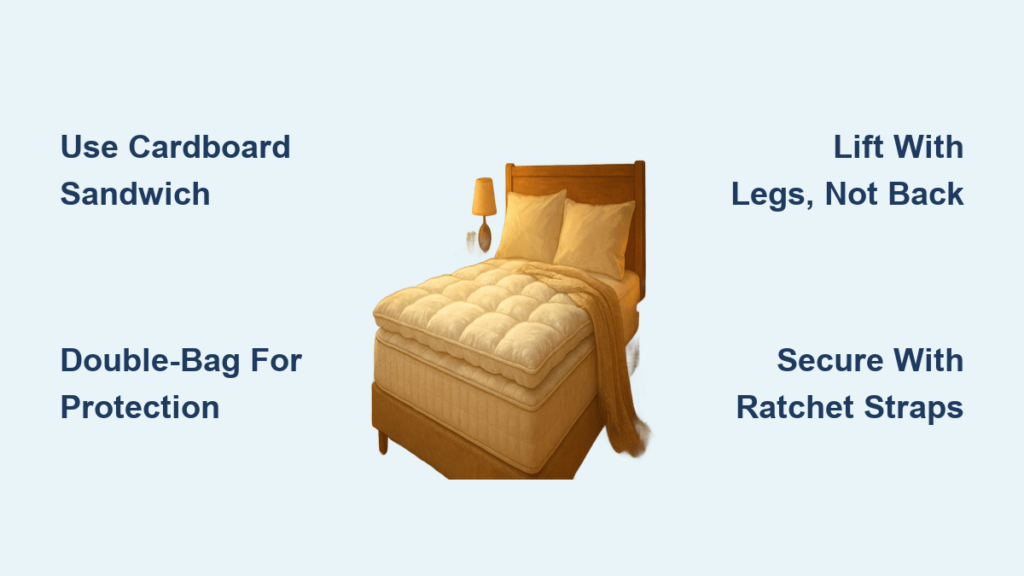
Cardboard reinforcement represents perhaps the most critical supply for moving a floppy mattress effectively. When a mattress lacks structural integrity, sandwiching it between two large pieces of cardboard creates a makeshift rigid platform that makes handling dramatically more manageable. This cardboard barrier prevents the mattress from bending or folding uncontrollably during transport and provides a stable surface for strapping or taping. Use heavy-duty corrugated cardboard—single-wall grade typically suffices, but double-wall offers extra rigidity for particularly floppy models. The cardboard pieces should extend several inches beyond the mattress edges on all sides to provide complete coverage and multiple attachment points for tape or straps.
Ratchet straps and heavy-duty packing tape complete your essential toolkit. Ratchet straps provide adjustable, secure fastening that won’t loosen during transit, while professional-grade packing tape creates secure seals on mattress bags and fastens cardboard reinforcement in place. Choose water-resistant, heavy-duty tape with strong adhesive properties, as cheap office tape often fails under the stress of moving. A dolly or hand truck with a mattress-specific attachment dramatically reduces the physical strain of moving a floppy mattress—standard dollies can work, but models designed for mattresses feature wider platforms and specialized straps that hold the mattress securely in an upright position.
Execute Proper Wrapping Techniques for Maximum Protection
The wrapping process is especially critical for floppy mattresses, as their lack of structural integrity makes them more vulnerable to damage during handling. A well-wrapped mattress remains protected from dirt, moisture, tears, and the physical stress of transport throughout the entire moving process.
Apply Mattress Bag Correctly for Optimal Coverage
Begin mattress bag application by laying the mattress flat on the ground or against a wall—having a helper for this step makes the process much easier. If using a mattress bag with handles, orient the bag so the handles will be positioned at the most convenient points for lifting. One person should lift one end of the mattress while the other slides the bag underneath, then work together to slide the bag over the entire mattress. Once the bag is in place, push out as much air as possible by pressing down on the mattress, then fold the excess bag material at the open end and seal it thoroughly with packing tape. Check the entire bag for small holes or tears and seal any you find with additional tape.
Implement the Cardboard Sandwich Method for Structural Support
For floppy mattresses, the cardboard sandwich technique provides essential structural support that transforms an unmanageable mattress into a handleable unit. Position the mattress flat, then place a large piece of cardboard underneath it, extending the cardboard several inches beyond the mattress edges on all sides. Place another identical piece of cardboard on top of the mattress, creating a cardboard-mattress-cardboard structure. Use packing tape to secure all edges of the cardboard together, effectively creating a rigid unit that can be lifted, carried, and loaded much more easily. The cardboard should be taped along all four sides, at multiple points along the edges, and across the center to prevent shifting during transport. For extremely floppy mattresses, consider using multiple layers of cardboard for additional rigidity.
Master Safe Lifting and Maneuvering Techniques
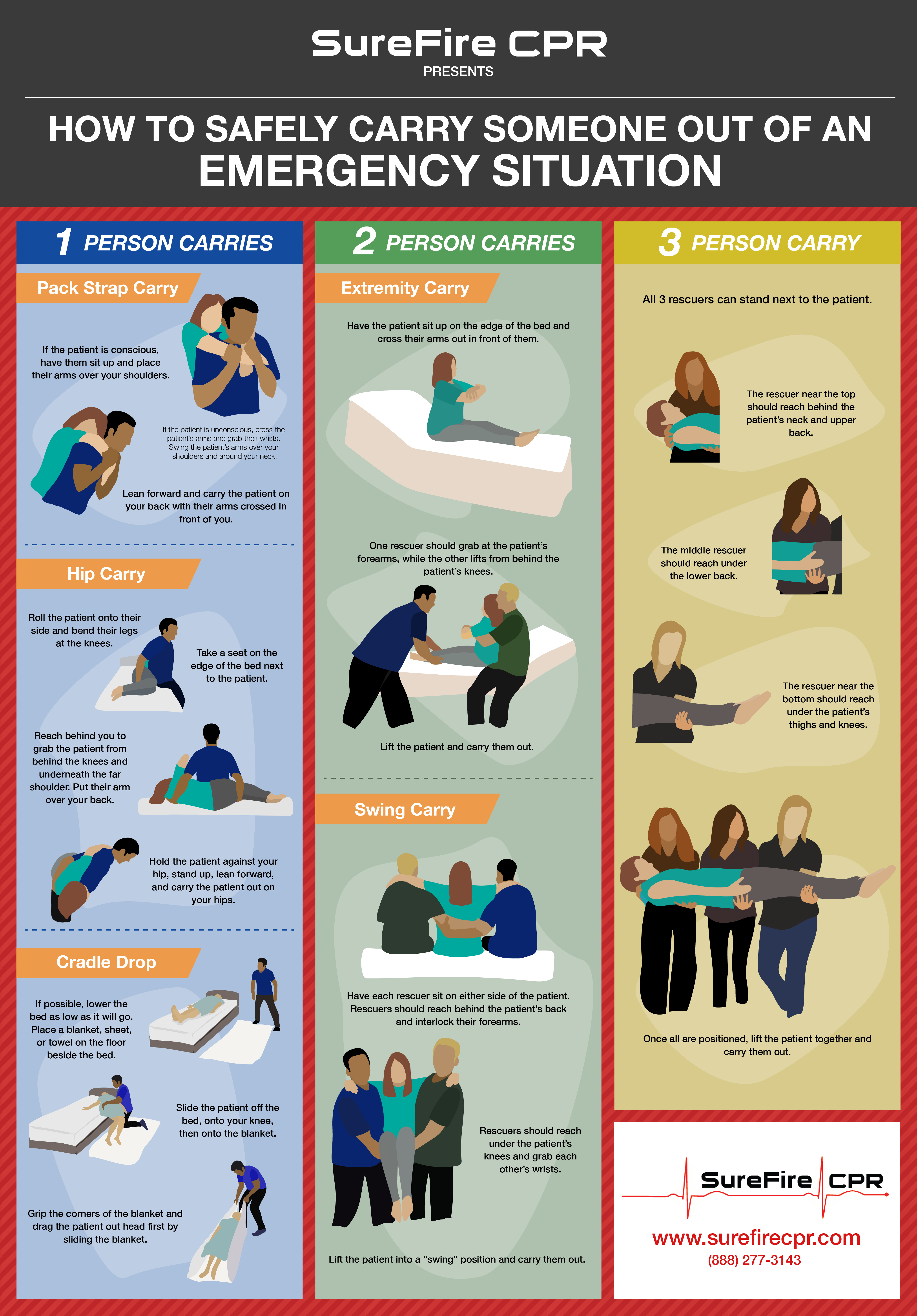
Proper lifting technique is essential for protecting both your body and your mattress during the moving process. Floppy mattresses present unique challenges because they don’t distribute weight predictably and can shift or bend unexpectedly during lifts, creating strain or injury risks if you aren’t prepared.
Lift with Your Legs and Maintain Proper Body Position
Always lift with your legs, not your back. Bend at the knees while keeping your back straight, and power the lift through your leg muscles. Keep the mattress as close to your body as possible throughout the lift—this provides better control and reduces the strain on your arms and back. For a floppy mattress, having two people lift simultaneously is ideal, with one person at the head end and one at the foot end. Communicate clearly throughout the process, using commands like “Ready… lift… now” to coordinate movements. Never twist your body while lifting the mattress; instead, move your feet to change direction. If the mattress begins to slip or shift during a lift, lower it gently and readjust your grip rather than trying to muscle through with compromised positioning.
Navigate Doorways and Stairs Without Causing Damage
When descending stairs with a helper, the person positioned below should support most of the weight while the person above guides and controls the descent. Keep the mattress on its side and move slowly, using the wall or railing for support and stability. The person below bears the primary weight, while the person above focuses on steering and preventing the mattress from swinging or hitting the walls. When ascending stairs, the opposite configuration works best—the person below lifts from the bottom while the person above guides from above. For doorways, tilt the mattress on its side and angle it slightly to pass through the frame—the diagonal dimension of a tilted mattress is greater than its width, allowing it to fit through standard doorways that would be otherwise too narrow.
Load and Secure Your Mattress for Safe Vehicle Transport

Getting the mattress into your vehicle and securing it properly for transport is where many moving problems occur. The right approach depends on your vehicle type and the distance of your move, with proper technique preventing damage during transit.
Choose the Right Vehicle and Loading Method
The best vehicle for transporting a floppy mattress is an enclosed moving truck or van, as these provide maximum protection from the elements and allow the mattress to lie flat or stand on its side without exposure. For loading into a moving truck or van, using a loading ramp makes the process much smoother if one is available. Position the ramp securely, then push or pull the mattress up the ramp using the cardboard-reinforced structure for grip. Once inside the truck, the best position for a floppy mattress is standing on its side against the wall, secured with tie-down straps or wedged between other large items.
Secure Your Mattress with Professional-Grade Straps
Proper securing is non-negotiable for safe transport. Inside an enclosed vehicle, use ratchet straps to anchor the mattress to wall rails or tie-down points. The straps should be tight enough to prevent any movement but not so tight that they compress or damage the mattress. If your vehicle lacks built-in tie-down points, create anchor points using heavy furniture or boxes secured with straps. Regardless of your setup, check the security of your mattress before departure and periodically during long drives, as vibrations and movement can loosen straps over time.
Avoid These 5 Common Floppy Mattress Moving Mistakes
Learning from others’ mistakes can save you significant trouble when moving a floppy mattress. These common errors lead to mattress damage, personal injury, or unnecessary frustration that proper preparation could prevent.
Never fold your mattress aggressively—improper folding causes permanent damage to foam cells and internal structures. If your mattress manufacturer provides specific folding instructions, follow those exactly, but otherwise avoid folding altogether. The cardboard sandwich technique provides rigidity without folding, which is the preferred approach.
Skipping protective wrapping to save time often leads to stained, damaged, or contaminated mattresses. Even short moves expose mattresses to dust, dirt, and potential moisture. A few dollars spent on quality protection pays for itself many times over in mattress condition preservation.
Failing to measure doorways and pathways before moving day leads to frustrating mid-move discoveries. Measure everything in advance—your mattress dimensions, all doorways along your route, and the cargo space of your transport vehicle.
Using improper lifting technique causes back injuries that could sideline you for weeks. Lifting with your back rather than your legs, twisting while lifting, and attempting to carry more weight than you can safely manage all lead to injury.
Neglecting weather considerations can ruin your mattress. Water can soak through even protected mattresses, leading to mold and mildew. If rain is forecast, wait for a clearer window or add extra protection layers.
Solo Moving Strategies When Help Isn’t Available
Moving a floppy mattress alone presents significant challenges but can be accomplished safely with proper planning and technique. When you don’t have help available, these strategies make the process manageable:
Double your protection by double-bagging your mattress and using high-quality tape to seal all openings. The cardboard sandwich technique becomes even more critical when working solo, as it provides the rigidity needed to maintain control of the mattress.
Create improvised solutions using items you likely have available. Furniture sliders placed under the cardboard allow you to slide a reinforced mattress across floors with minimal effort. A sturdy piece of rope tied around the mattress provides grip points for pulling.
Pace yourself carefully to avoid exhaustion-related injuries. Move slowly and deliberately, and don’t hesitate to rest when needed. Identify safe resting spots along your route before you begin moving, and plan to take breaks every few minutes even if you don’t feel tired yet.
When loading into a vehicle alone, position the vehicle close to your exit point to minimize carrying distance. Use the tailgate or rear door as a support point—tip the mattress onto its edge, then carefully walk it up and into the vehicle while supporting the weight against your body and the vehicle wall.
By following these comprehensive techniques and recommendations, you can successfully move even the flattest floppy mattress while protecting both your investment and your physical wellbeing. The key is preparation, proper equipment, careful technique, and patience throughout the process. With the right approach, what initially seems like an impossible task becomes a manageable project that you can complete confidently and efficiently.