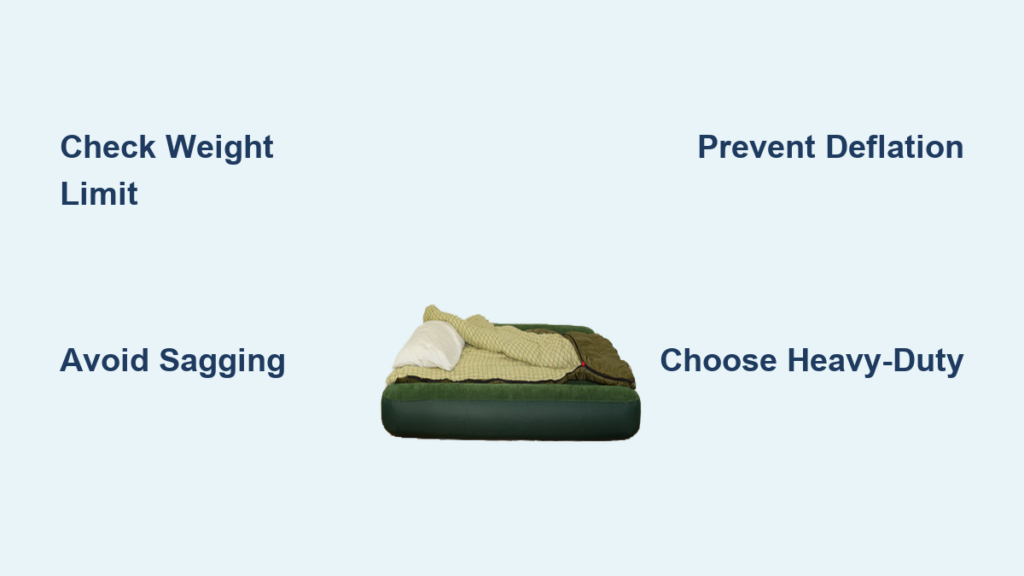
Waking up to a deflated air mattress at 3 AM isn’t just frustrating—it’s often the direct result of exceeding your air mattress weight limit. That unexpected collapse happens because the internal support structures can’t handle the load, leaving you stranded on the floor with a ruined night’s sleep. Most consumers focus solely on size and price when shopping for an air mattress, completely overlooking the single most critical specification: how much weight the mattress can actually support. Your body weight, plus bedding, pets, or even a partner rolling over, all contribute to the total load that determines whether your mattress will provide restful sleep or become a sagging, deflating disaster.
The consequences of ignoring weight limits extend far beyond one bad night. Consistently overloading your air mattress stretches materials beyond recovery, creating permanent weak points that lead to leaks, seam failures, and dramatically reduced lifespan. A mattress rated for 500 pounds might seem sufficient for two 250-pound adults, but add just a 20-pound weighted blanket and you’ve already exceeded capacity without accounting for the dynamic forces of movement during sleep. Understanding how weight limits work, what factors affect them, and how to select the right capacity for your specific needs transforms your air mattress from a potential liability into a reliable sleeping solution.
This guide cuts through the confusion with specific, actionable information about air mattress weight limits. You’ll discover exactly how much weight different sizes can handle, what construction features determine capacity, and how to select the perfect mattress for your body type and sleeping habits—whether you’re buying for occasional guests, regular use, or outdoor adventures.
Why Exceeding Air Mattress Weight Limits Causes Immediate Problems
Sagging Leads to Painful, Unsupportive Sleep
When your body weight pushes an air mattress beyond its design limits, the surface deforms into an uncomfortable hammock shape that throws your spine out of alignment. This sagging creates pressure points on your hips, shoulders, and lower back that prevent deep, restorative sleep. You might toss and turn all night trying to find a comfortable position, only to wake with stiffness that lingers long after you’ve left the mattress. The worst part? This discomfort often sneaks up on you—your mattress might seem fine at first, but as materials stretch under excessive load, support gradually deteriorates until you’re sleeping in a literal depression.
Rapid Deflation Creates Safety Hazards
The most dangerous consequence of exceeding weight limits is sudden, unexpected deflation. When internal air chambers or support beams fail under excessive pressure, your mattress can lose air in seconds, dropping you to the floor without warning. This risk is particularly serious for older adults, children, or anyone sleeping on an elevated surface. Even floor-level air mattresses become tripping hazards when they deflate unevenly during the night. I’ve heard countless stories from users who woke up on the floor with bruises they couldn’t explain—until they realized their combined weight with bedding had exceeded the mattress’s capacity by 50 pounds.
Permanent Damage Occurs Before You Notice
Exceeding weight limits causes invisible damage long before obvious problems appear. Each time you overload your mattress, the PVC or vinyl materials stretch microscopically at stress points. These tiny deformations accumulate with each use, creating weak spots that eventually lead to leaks, seam separation, or complete structural failure. A mattress that seems fine after one overloaded night might require constant re-inflation after the third use, then develop a persistent leak by the fifth. By the time visible damage appears, the structural integrity has already been compromised beyond repair.
Air Mattress Weight Capacity by Size: Exact Numbers

Twin Air Mattress Weight Limit: 300-400 Pounds
Standard twin air mattresses support 300-400 pounds, making them suitable for single adults under 200 pounds. The smaller dimensions (typically 38″x75″) concentrate weight on a limited surface area, so even lightweight couples should avoid sharing a twin—two 150-pound adults would max out a 300-pound capacity mattress before adding bedding weight. Heavy-duty twin models reach 600 pounds for larger individuals, but these remain impractical for two adults due to space constraints. If you’re over 200 pounds, choose a full or queen size even for solo use—extra surface area distributes weight more effectively, reducing stress on any single point of the mattress.
Full Air Mattress Weight Limit: 400-450 Pounds
Full size air mattresses (54″x75″) support 400-450 pounds, accommodating single sleepers up to 250 pounds or couples totaling under 400 pounds. The additional width compared to twins provides more sleeping space without significantly increasing capacity requirements. However, be cautious with weight distribution—a 220-pound partner sharing with a 150-pound partner (total 370 pounds) might experience uneven support that causes discomfort for the heavier sleeper. If either partner exceeds 200 pounds, size up to a queen for proper weight distribution and long-term durability.
Queen Air Mattress Weight Limit: 500-600 Pounds
Queen size air mattresses (60″x80″) dominate the market with 500-600 pound capacities—the sweet spot for most couples. This translates to 250-300 pounds per person, comfortably accommodating adults of average weight with margin for bedding and movement. The larger surface area spreads weight more effectively than smaller sizes, reducing stress on materials. Couples approaching 500 pounds combined should consider heavy-duty queen models (700-800 pounds) or standard king sizes to prevent premature wear. Remember that a queen rated for 600 pounds doesn’t mean two 300-pound people—it accounts for dynamic forces during sleep that effectively increase load by 20-30%.
King Air Mattress Weight Limit: 600-1000 Pounds
King size air mattresses (76″x80″) support 600-1000 pounds, making them ideal for heavier couples, families with children, or anyone prioritizing maximum sleeping space. The additional width distributes weight across a larger area, reducing pressure on any single point. Standard king models (600-750 pounds) suit couples where one or both partners exceed queen size limits, while heavy-duty kings (800-1000 pounds) accommodate nearly any combination of sleepers. The trade-off? Kings require significant floor space, weigh more when deflated, and present greater storage challenges. Measure your room before purchasing—many standard bedrooms can’t comfortably fit a full-size king mattress with walking space on both sides.
How Construction Determines Real-World Weight Capacity
Material Thickness Matters More Than You Think
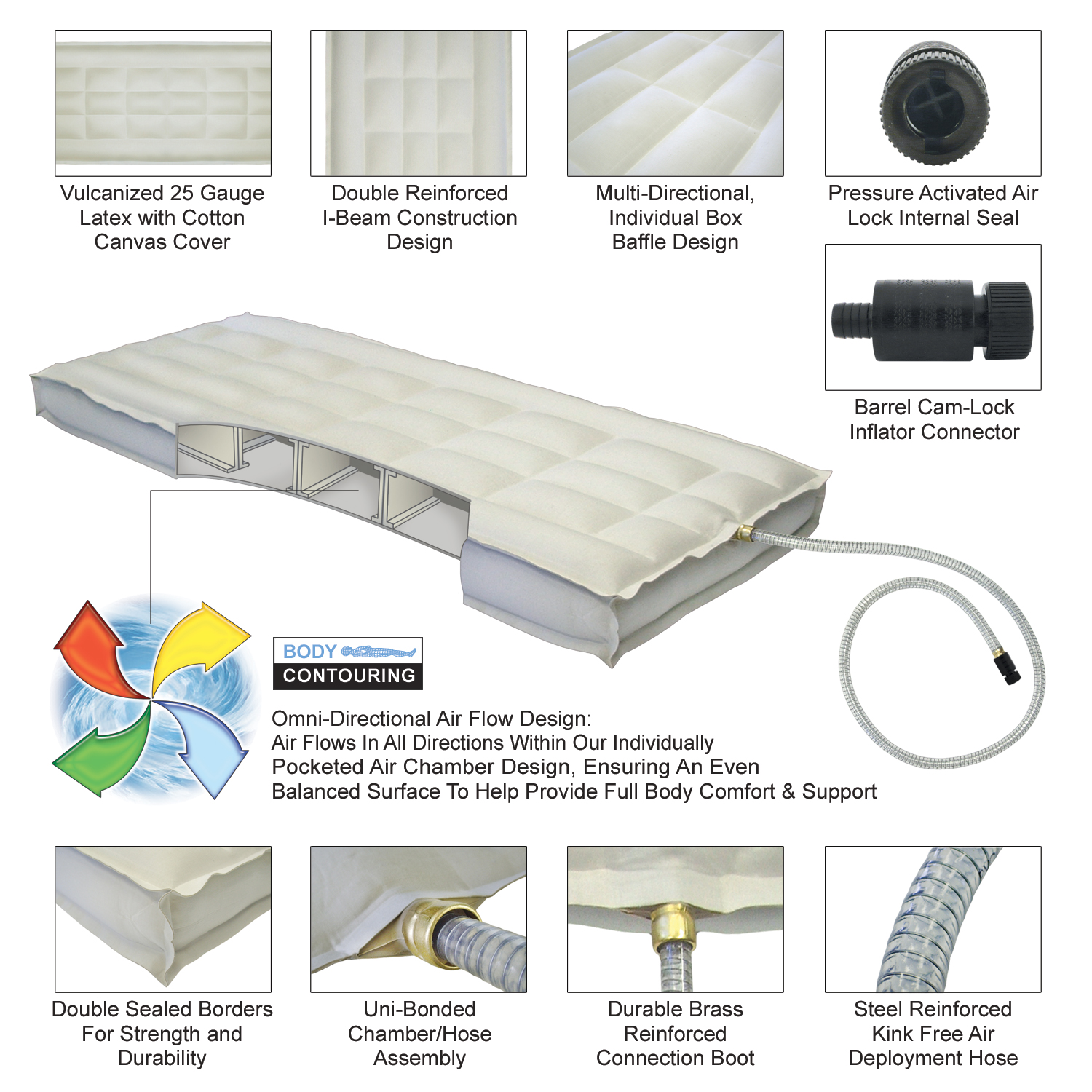
Most air mattresses use 14-18 gauge PVC vinyl, with lower numbers indicating thicker, stronger material. Standard models typically use 18-gauge (thinner) vinyl that stretches more easily under load, while premium models feature 14-gauge (thicker) vinyl that maintains shape and support under heavier weights. Heavy-duty mattresses often incorporate rubber composites or thermoplastic polyurethane that resist stretching 30-50% better than standard vinyl. When comparing models, prioritize material thickness over stated weight capacity—two mattresses rated for 600 pounds may perform very differently based on construction quality.
Internal Support Systems Make or Break Weight Capacity
Modern air mattresses use three primary support systems that dramatically affect weight handling:
- Air coils (individual inflatable columns): More coils = better weight distribution. Premium models feature dozens of coils that function like miniature springs, preventing uncomfortable sinking.
- Air beams (tubular cross-structures): Create a ribbed framework that maintains uniform air pressure. More beams = less center sagging when one person sleeps in the middle.
- Chambers (separate air sections): Often feature independent firmness control. The walls between chambers create reinforced center rails that enhance edge support.
The best heavy-duty models combine all three systems for maximum weight capacity. Look for terms like “multi-beam construction” or “reinforced coil system” in product descriptions—they signal superior weight-handling capabilities.
Heavy-Duty Air Mattresses: When Standard Models Won’t Cut It
Who Needs 700+ Pound Capacity Models
Standard air mattresses work for people within their rated capacities, but these users need heavy-duty options:
– Single adults over 300 pounds
– Couples with combined weights exceeding 500 pounds
– Anyone using weighted blankets (adds 10-20+ pounds)
– People who move significantly during sleep (creates dynamic loads 20-30% higher than static weight)
Heavy-duty models cost 20-50% more than standard versions but provide the support and longevity that heavier users require. The market has expanded significantly—where once heavier shoppers faced limited options, today’s market offers numerous models rated for 700, 800, or even 1000 pounds.
Spot Heavy-Duty Construction Features
When shopping for high-capacity air mattresses, look for these construction features that signal true heavy-duty capability:
- Material gauge below 14 (thicker vinyl)
- Rubber or rubber composite materials (superior to standard PVC)
- Reinforced seam stitching (double or triple-stitched seams)
- Multiple internal support systems (coils + beams + chambers)
- Higher coil count (40+ coils for queen size)
Avoid models that simply state “heavy-duty” without specifying construction details—many budget brands use the term misleadingly without substantial upgrades to materials or support systems.
Finding Your Air Mattress Weight Limit When Labels Are Missing
Locate Hidden Model Information
If your air mattress label has worn off or become illegible, check these often-overlooked locations:
– Inside valve caps (remove and inspect)
– Bottom center panel (flip mattress over)
– Edge seams (particularly near inflation points)
– Original packaging or receipt (may have model number)
Most manufacturers include model numbers in multiple locations on the mattress itself. Once you have the model number, visit the manufacturer’s website or contact customer service—they maintain databases of specifications for all past and current models.
Verify Weight Capacity Through Testing
When you can’t find official specifications, perform this simple test to estimate capacity:
1. Inflate mattress to recommended firmness
2. Place a digital scale in center of mattress
3. Gradually add weight (books, weights, etc.) until surface depresses 2+ inches
4. The weight at which significant sagging occurs is approximately 80% of true capacity
This method isn’t perfect but provides a practical safety margin—never exceed 80% of the weight where noticeable sagging begins.
Critical Mistakes That Shorten Air Mattress Lifespan

Overlooking Bedding Weight Adds Hidden Load
Most users forget that sheets, blankets, and especially weighted blankets contribute meaningfully to total load. A 20-pound weighted blanket effectively reduces your 600-pound queen mattress capacity to 580 pounds—potentially problematic for a 290-pound couple. Factor bedding weight into your calculations, particularly with weighted blankets that can add 10% of your body weight. When near capacity limits, switch to lightweight microfiber or bamboo bedding that provides comfort without adding significant weight.
Ignoring Temperature Effects on Air Pressure
Air expands and contracts with temperature changes, effectively altering weight capacity throughout the night. A properly inflated mattress at 70°F becomes over-pressurized at 80°F (reducing effective capacity) and under-pressurized at 60°F (causing sagging). Check and adjust inflation before bed, especially in climate-controlled environments where temperature fluctuations are minimal but still impactful. Many users don’t realize their “sagging” mattress in the morning is simply the result of overnight temperature changes reducing air pressure.
Your Air Mattress Weight Limit Cheat Sheet
| Mattress Size | Standard Capacity | Heavy-Duty Capacity | Best For |
|---|---|---|---|
| Twin | 300-400 lbs | Up to 600 lbs | Single adults under 200 lbs |
| Full | 400-450 lbs | Up to 600 lbs | Single adults under 250 lbs or lightweight couples |
| Queen | 500-600 lbs | 700-800 lbs | Most couples (combined under 500 lbs) |
| King | 600-750 lbs | 800-1000 lbs | Heavier couples or families with children |
When selecting your air mattress, choose a capacity at least 100-150 pounds above your total expected load (body weight + bedding). This buffer accommodates material degradation over time and the dynamic forces of movement during sleep. The extra investment pays dividends in comfort, safety, and longevity—your air mattress should support your sleep, not sabotage it.