Ever wake up to find your fitted sheet has completely abandoned your mattress, bunched up in the middle like a failed origami project? That frustrating experience happens to millions of sleepers who don’t realize their fitted sheet simply doesn’t match their mattress depth. Learning how to measure a mattress for a fitted sheet correctly is the solution to this nightly battle, ensuring your bedding stays securely in place while providing that smooth, comfortable surface you deserve. Without accurate measurements, you’re essentially gambling with your sleep quality every time you purchase new sheets.
Modern mattresses have evolved far beyond the simple flat surfaces of previous generations. Today’s beds feature pillow tops, memory foam layers, cooling gel inserts, and other comfort technologies that dramatically increase overall thickness. Add a mattress topper or protector into the mix, and the total depth can easily exceed what standard sheets are designed to handle. The result? Sheets that either won’t stay on or create uncomfortable bunching that disrupts your sleep.
This guide delivers everything you need to know about measuring your mattress correctly, selecting the right sheet pocket depth, and avoiding the common pitfalls that lead to poorly fitting sheets. You’ll learn professional measurement techniques, how to account for special mattress types, and exactly what depth specifications to look for when shopping. By the end, you’ll have the knowledge to find fitted sheets that stay put all night long.
Gather Your Measurement Tools Before Starting

Skip the frustration of inaccurate measurements by assembling the right tools before you begin. A flexible measuring tape remains the gold standard for mattress depth measurement because it bends easily along the mattress edges without losing accuracy. Look for one with clear inch and centimeter markings—avoid rigid rulers that can’t conform to curved mattress corners. A cloth or fiberglass tape that measures at least 60 inches long gives you the most versatility for different mattress depths.
If you don’t have a flexible tape measure immediately available, try these household alternatives:
- String and ruler method: Wrap string around the mattress edge at the deepest point, mark where it meets, then measure the string against a ruler
- Book as straight edge: Place a hardcover book across the mattress surface to bridge crowned areas before measuring
- Yardstick technique: Use for straight-edge measurements on flat surfaces but be careful with rounded corners
Critical tip: For crowned mattresses (those higher in the center), you absolutely need a straight edge like a yardstick or level. Without it, you’ll get falsely low measurements that guarantee ill-fitting sheets.
Strip Your Bed Completely for Accurate Results
Before taking any measurements, remove all bedding from your mattress—sheets, blankets, comforters, and pillows. Any fabric left in place creates irregularities that throw off your readings. However, leave mattress toppers and protectors in place if you use them regularly. These accessories can add 1-4 inches of thickness that must be included in your measurement.
Check that your mattress sits evenly on its foundation before measuring. An unevenly positioned mattress creates apparent depth variations that don’t reflect reality. If your mattress appears tilted or has shifted on the box spring, reposition it squarely. This simple step prevents the common mistake of measuring a mattress that’s actually sitting at an angle.
Pro warning: Don’t measure while standing on the bed! Your body weight compresses memory foam and pillow-top mattresses, giving you falsely low readings. Stand beside the mattress and let your measuring tool rest gently against the surface without applying downward pressure.
Measure Mattress Depth at Multiple Points
Position your measuring tape at the bottom edge where the mattress meets the foundation, then extend it vertically straight up to the top surface. Crucially, measure toward the center of the bed rather than at the corner—corners often sit differently than the main mattress body. Take measurements at least three different locations around the perimeter, especially if you have a pillow-top or memory foam mattress that may vary in thickness.
For crowned mattresses (common with innerspring designs), use the straight edge technique: Place your yardstick across the mattress surface spanning from edge to edge. Measure from the bottom edge of the mattress up to the bottom of this straight edge. This captures the true maximum depth rather than the lower measurement you’d get from the curved center.
Time-saving tip: Complete your measurements in under 3 minutes by following this sequence: strip bed → position straight edge (if needed) → measure side 1 → measure side 2 → measure side 3 → record deepest measurement. Always use the deepest reading as your reference point—sheets sized for the shallowest measurement will pop off at the thickest corners.
Calculate Total Depth With Toppers and Protectors
Mattress toppers, pads, and protectors can transform a standard-depth mattress into one requiring deep-pocket sheets. A quality memory foam topper adds 2-4 inches, while a featherbed can contribute even more. Mattress pads and protectors typically add 1-2 inches each, and using multiple accessories compounds this effect.
When measuring with these additions in place, follow the same procedure: measure from the bottom edge to the top surface of the combined layers. Never measure your bare mattress then estimate topper thickness—this common mistake leads to underestimating total depth. Take measurements at several points across the surface; pillow-top mattresses and thick toppers often appear fluffier in the middle than at the sides.
Critical calculation: If your bare mattress measures 12 inches and your topper adds 3 inches, you need sheets designed for 15+ inch depths—not standard 14-inch sheets. That extra inch makes the difference between secure corners and nightly frustration.
Match Your Measurement to Sheet Pocket Depths
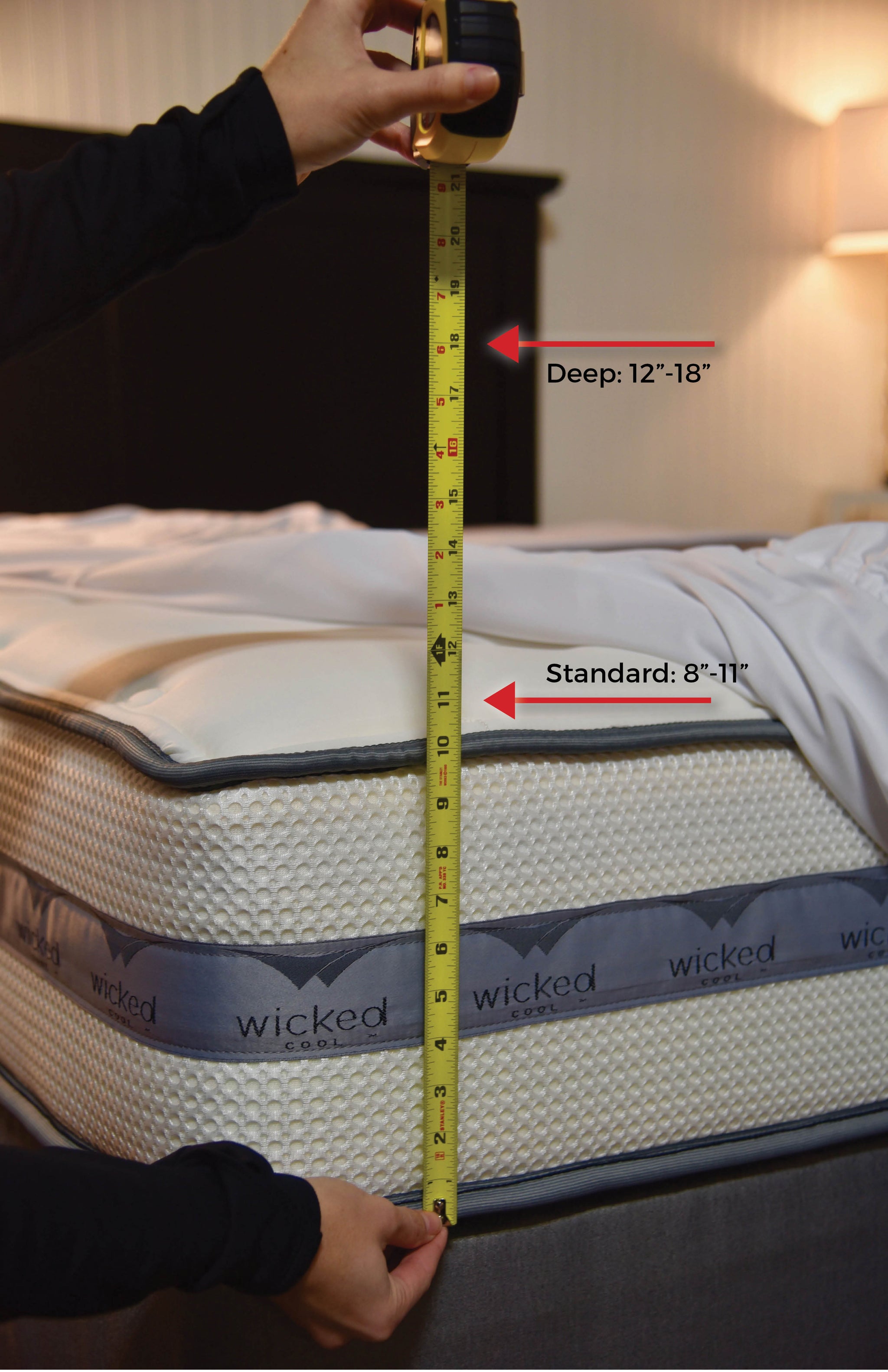
Mattress depths fall into specific categories that correspond to fitted sheet pocket depths. Understanding these categories prevents you from guessing at sheet sizes:
- Standard pocket sheets (8-12 inches): Work for basic innerspring mattresses without pillow tops
- Deep pocket sheets (13-17 inches): Required for most pillow-top, memory foam, and hybrid mattresses
- Extra-deep pocket sheets (18+ inches): Necessary for ultra-plush mattresses with thick toppers
Manufacturer warning: What one brand calls “deep pocket” might differ significantly from another. Always check the specific pocket depth measurement listed in product specifications rather than relying on descriptive categories. A sheet labeled “fits up to 16 inches” won’t work for your 17-inch mattress, no matter how “deep” the marketing claims it is.
Add Essential Depth Buffer for Secure Fit
Select sheets with pocket depth 1-2 inches deeper than your measured mattress depth. If your mattress measures 14 inches deep, choose sheets with 15-16 inch pockets. This buffer ensures:
- Enough fabric for secure tucking under the mattress edge
- Accommodation for mattress compression over time
- Room for minor fabric shrinkage after washing
Fabric-specific advice: For linen sheets, which soften and conform with use, rotate between multiple sets weekly to maintain fit. Cotton sheets may experience minor shrinkage after initial washes, making that extra depth buffer even more valuable.
Avoid These 4 Measurement Mistakes
Measuring Only One Side
Many mattresses have slight depth variations around their perimeter. Measure all four sides and use the deepest reading—measuring just one side risks purchasing sheets too small for thicker corners.
Forgetting Toppers During Measurement
This single mistake causes more sheet fit problems than any other. Measure with your complete sleep system in place if you want sheets that fit your actual setup.
Applying Pressure While Measuring
Leaning on memory foam mattresses compresses the surface, giving falsely low readings. Stand beside the mattress and let the tape rest gently against the surface.
Measuring Diagonally
Measuring from top corner to bottom corner creates a diagonal reading that exceeds true vertical depth. Always measure straight up and down, perpendicular to the foundation.
Special Mattress Types Require Special Techniques

Pillow-Top Mattresses
Measure at the center where the pillow-top layer reaches maximum thickness. Many pillow-tops require deep-pocket sheets (13-17 inches), with ultra-plush versions needing extra-deep options.
Memory Foam Mattresses
Take quick, light-handed measurements without pressing down. Memory foam compresses significantly under pressure, so slower measurements give inaccurate readings.
Adjustable Bed Mattresses
Measure in both flat and bent positions if you regularly sleep with the head or foot elevated. The bending mechanism affects how the mattress sits and its effective depth.
Troubleshoot Existing Sheet Problems
Corners Popping Off?
Your sheets are too shallow. Re-measure including all toppers and purchase sheets with adequate pocket depth. Alternatively, replace worn elastic or use sheet suspenders that clip to corners.
Excess Fabric Bunching?
Your sheets have too much pocket depth. Exchange for a shallower option—choose sheets 1-2 inches deeper than your mattress, not 4-5 inches.
Uneven Fit Across Corners?
Your mattress has depth variations. Use the deepest measurement for sheet selection and consider sheet straps to maintain consistent grip.
Quick Reference Depth Guide
– Mattresses ≤12 inches: Standard pocket sheets
– Mattresses 13-17 inches: Deep pocket sheets
– Mattresses ≥18 inches: Extra-deep pocket sheets
When in doubt between two sizes, always choose the deeper option. A sheet with slightly more pocket depth than necessary will still fit securely, while one that’s marginally too small creates nightly frustration. Taking just five minutes to measure correctly ensures perfectly fitting sheets that stay put and deliver the comfortable sleep surface you deserve.