Finding the right mattress for your recreational vehicle feels like solving a puzzle with missing pieces. Unlike standard home mattresses that follow predictable dimensions, camper mattress size chart specifications vary dramatically across RV models, manufacturers, and even different years of the same vehicle line. A mattress that fits perfectly in your friend’s travel trailer might be 3 inches too long for your Class C motorhome, leaving you with costly returns and uncomfortable nights. This frustrating reality stems from the RV industry’s lack of standardized sizing—where “queen” can mean anything from 60″ x 75″ to 60″ x 80″, and “king” might actually be 4 inches narrower than what you’d buy for your home.
The consequences of guessing wrong extend beyond wasted money and time. An ill-fitting mattress creates dangerous gaps where items can fall and get lost, compromises sleep quality with uncomfortable edges, and might even interfere with slide-out mechanisms or storage compartments. Understanding the nuances of RV-specific sizing prevents these headaches and ensures you get restful sleep no matter where your adventures take you. This guide delivers the precise measurements, practical measurement techniques, and material considerations you need to select the perfect mattress for your specific RV configuration.
Standard RV Mattress Dimensions You Must Know
RV mattress sizes differ from residential standards in both width and length, with some variants sharing identical dimensions while others vary by several inches. Understanding these differences proves essential when shopping for replacement mattresses, as purchasing based on residential sizing assumptions frequently leads to fitment problems.
Complete Size Reference Chart
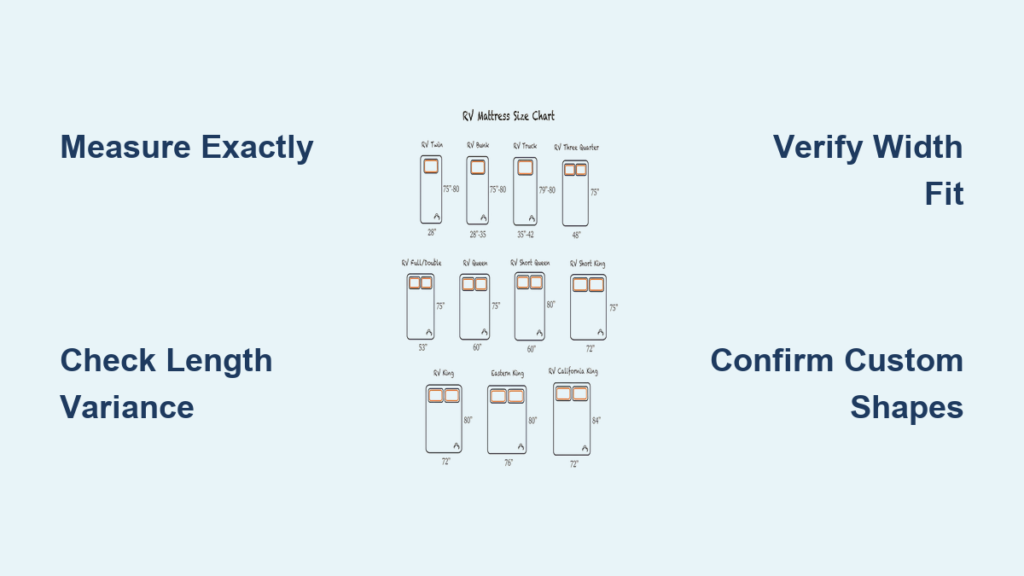
The following table covers all standard camper mattress sizes with their dimensional specifications in both inches and centimeters:
| Mattress Size | Width (inches) | Length (inches) | Width (cm) | Length (cm) |
|---|---|---|---|---|
| RV Twin | 28-38 | 75-80 | 71-96 | 191-203 |
| RV Twin XL | 38 | 80 | 96 | 203 |
| RV Three Quarter | 48 | 75-80 | 122 | 191-203 |
| RV Full / Double | 53-55 | 75-80 | 135-140 | 191-203 |
| RV Short Queen | 60 | 74-75 | 152 | 188-191 |
| RV Queen | 60 | 80 | 152 | 203 |
| RV Short King | 72 | 75 | 183 | 191 |
| RV King | 72-76 | 80 | 183-193 | 203 |
| RV California King | 72 | 84 | 183 | 213 |
| Eastern King | 76 | 80 | 193 | 203 |
| RV Bunk | 28-35 | 75-80 | 71-89 | 191-203 |
| RV Truck | 35-42 | 79-80 | 89-107 | 201-203 |
Why Your RV Queen Isn’t Like a Home Queen

Queen-sized mattresses in RVs come in two distinct variants that RV owners must clearly distinguish between when shopping for replacements. The standard RV queen measures 60 inches wide by 80 inches long, identical to residential queen dimensions and commonly found in larger travel trailers and Class A motorhomes. The RV short queen, however, measures 60 inches wide by 74-75 inches long, making it 5-6 inches shorter than the standard version. This short queen represents the most popular camper mattress size in the industry, appearing in countless travel trailers, fifth-wheelers, and Class C motorhomes.
Critical mistake to avoid: Assuming “queen” means the same thing across all RVs. Many RV owners order replacement mattresses based on the size label alone, only to discover their new mattress is too long for the bed frame. Always measure your actual space rather than relying on the manufacturer’s size designation.
King-Sized RV Mattresses Decoded
King-sized RV mattresses require careful attention to dimension specifications due to significant differences from residential king sizes. The standard RV king measures 72 inches wide by 80 inches long, making it 4 inches narrower than a residential Eastern king while maintaining the same length. This width reduction accommodates the more constrained bedroom spaces typical in RVs while still providing generous sleeping surface for couples.
The RV short king takes additional length off the standard king dimensions, measuring 72 inches wide by 75 inches long. This variant suits RVs needing large mattress width but facing length limitations from slide-out configurations. For luxury motorhomes, the RV California king measures 72 inches wide by 84 inches long, matching residential California king dimensions.
Measuring Your RV Sleep Space Like a Pro
Accurate measurement of your RV sleeping area represents the single most important step in purchasing a replacement mattress. Unlike residential beds with standardized dimensions, RV bed frames and platforms frequently vary from manufacturer to manufacturer, and even within the same brand across different model years.
Essential Measurement Steps That Prevent Returns
Begin by removing all bedding and your existing mattress. Using a flexible tape measure, measure the width of the bed platform at its widest point, recording this dimension in both inches and centimeters. Next, measure the length from the headboard or front edge of the platform to the foot of the bed. Finally, measure the height clearance if you have overhead cabinets or slide-out mechanisms.
Pro tip: Take multiple measurements at different points along the platform. RV bed frames sometimes feature slight variations in dimension across their length. Measure at the head, middle, and foot of the bed to identify any irregularities that might affect mattress selection.
Handling Irregular Shapes That Standard Charts Ignore
RV beds frequently feature non-standard design elements that require additional consideration during measurement. Rounded corners, angled cuts for wheel wells, and notched sections all necessitate detailed documentation. When dealing with angled corners, measure both the straight sections and the angle itself, noting the degree of cuts or the radius of rounded corners.
For beds in slide-outs, test the complete range of motion before measuring to ensure the mattress won’t interfere with the mechanism. Some RVs require hinged mattresses that fold up during travel—these specialized constructions cannot be replaced with standard alternatives without significant modification.
RV Mattress Types Compared for Real-World Use
Understanding the different mattress constructions available for RVs helps owners select options that balance comfort, durability, and practical considerations for the unique demands of recreational vehicle use.
Foam Mattress Options for Weight-Conscious RVers
Foam mattresses represent the most common original equipment in modern RVs due to their lightweight construction. Standard RV foam mattresses typically measure 5-6 inches in thickness, significantly thinner than residential counterparts. This reduced thickness minimizes vehicle weight and fits within limited vertical clearances.
Important consideration: The lightweight nature of foam mattresses (20-30 pounds) makes them easier to maneuver through narrow RV hallways, but the thinner profile means less cushioning. Many RV owners find standard foam inadequate for quality sleep on extended trips.
Memory Foam Challenges in Variable RV Climates
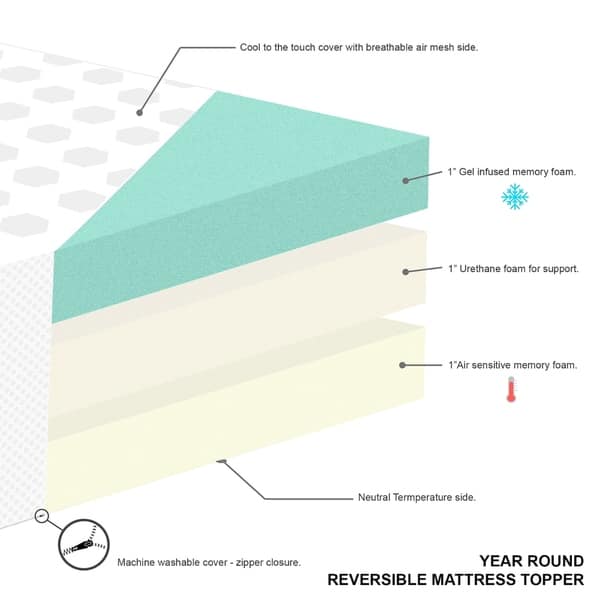
Memory foam mattresses offer excellent body contouring but present unique challenges in RV environments. Memory foam is temperature-sensitive, becoming softer as it warms and harder as it cools. When exposed to temperatures below 60°F, memory foam can become extremely firm, potentially requiring 5-6 hours to warm to comfortable consistency.
Warning: Memory foam is problematic for RVers who travel in cooler climates or store vehicles in unheated facilities during off-seasons. The temperature fluctuations common in RVs can make memory foam uncomfortably firm at night and overly soft during warm daytime temperatures.
Hybrid Mattresses: Best of Both Worlds?
Hybrid mattresses combine pocketed coil systems with foam comfort layers, delivering support with pressure relief. These mattresses typically range from 8-14 inches in thickness and weigh 80-100 pounds for queen-sized configurations.
Key advantage: The coil system provides excellent breathability, allowing the mattress to warm and cool faster than all-foam alternatives. This helps reduce condensation and mold growth within the RV sleeping area—a critical consideration for full-time RVers.
Custom and Specialty Sizes You Won’t Find on Standard Charts
Many RVs feature sleeping areas with dimensions that don’t correspond to any standard mattress size, requiring custom fabrication for proper fit. Common non-standard sizes include 49″ x 79″ used in Winnebago Revel models, 28″ x 76″ and 28″ x 72″ found in various Class B motorhomes.
Specialty Corner Configurations That Standard Mattresses Ignore
RV beds frequently incorporate custom corner designs to fit around structural elements. Rounded corners feature smaller corner radii than standard residential mattresses. Angled corners incorporate chopped-off sections that accommodate diagonal space constraints around wheel wells. Notched corners feature L-shaped cuts designed to fit around permanent fixtures or access panels.
Hinged Mattress Requirements Your Camper Mattress Size Chart Won’t Show

Many RVs require mattresses with hinged sections that fold to facilitate storage or slide-out mechanisms. These hinged mattresses feature specialized construction with flexible hinge mechanisms. Common configurations include folding in half for vertical storage or creating lift-up sections for under-bed compartments.
Critical step: When ordering replacement hinged mattresses, specify the exact hinge location, folding direction, and required clearance dimensions. A standard mattress won’t function properly in a space designed for a hinged configuration.
Popular RV Model Specifications by Class
Different RV classes feature distinct mattress configurations reflecting their varying sizes and design priorities.
Class A and Class C Motorhome Mattress Sizes
Class A motorhomes typically feature the most spacious sleeping areas, often accommodating standard residential-sized mattresses. King dimensions commonly measure 72″ x 80″ and queen sizes at 60″ x 80″. Class C motorhomes typically feature queen-sized or full-sized sleeping areas with the short queen (60″ x 75″) appearing frequently in models from Winnebago, Jayco, and Thor Motor Coach.
Class B Camper Van Mattress Challenges
Class B motorhomes feature the most compact sleeping areas and frequently require custom-sized mattresses. Common configurations include RV Full sizes around 54″ x 75″ and RV Twin sizes measuring approximately 28-30″ x 74-75″ each for bunk-style arrangements. Some manufacturers like Airstream offer innovative rear bed systems spanning the full van width.
Pop-Up Camper Mattress Solutions
Pop-up campers typically use smaller mattress sizes due to compact folded dimensions. Common sizes include twin (38″ x 75″) for basic models and full (53″ x 75″) for larger expandable trailers. Many pop-up campers incorporate custom-sized mattresses for dinette or Murphy bed configurations.
Key Buying Considerations Most RVers Overlook
When selecting a new camper mattress, balance comfort requirements with practical constraints. Consider how frequently you use your RV, typical climate conditions, and whether the mattress serves as primary or occasional sleeping accommodation.
Weight matters more than you think: A standard residential queen mattress may weigh 150 pounds, while a comparable RV queen often weighs 60-80 pounds. This weight difference significantly impacts your RV’s Gross Vehicle Weight Rating and fuel efficiency.
Thickness restrictions are critical: While residential mattresses may reach 18-36 inches in total height, most RV mattresses range from 5-10 inches. Thicker mattresses may create problems with adjacent elements including cabinet doors that open over the bed.
Full-time RVers generally benefit from higher-quality mattresses with greater thickness and support, while occasional users may find standard replacements adequate. Custom mattresses, while more expensive, often provide superior value when accounting for proper fit and elimination of gaps that plague improperly sized mattresses. Always measure your space before purchasing—never rely solely on manufacturer size labels or standard camper mattress size chart references.